Eat local
Grabbing a bite out? Why not frequent your favorite LOCAL joint?
There is something I’ve been thinking about lately every time I decide where to eat. Not what I want to eat. That part is usually easy (well, not always actually).
It's where.
Choosing a restaurant has started to feel like something more consequential than deciding between pizza, a burger or a plate of pasta. In an economy where nearly everyone is looking harder at the price at the bottom of the check, our dining dollars have become votes.
And I find myself increasingly wanting to cast mine for San Antonio. I want the neighborhood restaurant to survive. I want the chef who took a chance on a tiny dining room to be able to keep cooking there. I want the brewery where the owner might actually be sitting three stools away from me to make it through another year. I want young cooks (like me, well young as experience and school goes!) to have interesting kitchens where they can learn. I want bartenders, servers, dishwashers, bakers and line cooks to have places to work. Mostly, I want San Antonio to continue tasting like San Antonio.
That doesn't happen automatically.
It's a tough time to be a restaurant owner.
Restaurants have never been an easy business, but 2026 has made the margins particularly unforgiving.
The National Restaurant Association says restaurant operating costs remain elevated, with food and labor each consuming roughly a third of every sales dollar. Customer traffic has also been uneven, and inflation-adjusted restaurant sales are now projected to grow only about 0.8 percent this year.
Here in San Antonio, we're watching what that looks like in real time. Restaurants are disappearing.
August alone brought another round of closures around the city, following others earlier in the summer. The San Antonio Business Journal recently put the problem particularly starkly: the city's middle tier of casual restaurants is closing faster than it is opening, and those businesses depend heavily on regular customers who simply show up.
Then came the late-August storm, knocking out power across San Antonio and leaving restaurants confronting spoiled inventory, lost weekend service and expensive recovery costs. For a giant corporation, a bad weekend is a line on a quarterly report. For an independent restaurant, a lost Friday and Saturday can matter enormously.
That's why the answer to "Where should we eat tonight?" matters more than we sometimes realize.
The dollar doesn't stop at the register.
One of the strongest arguments for eating locally isn't sentimental at all. It's economic.
There is something economists call the local multiplier effect. When we spend money with an independently owned business, a greater share of that money tends to stay in the community. The business pays employees who live here. It hires a local plumber when the sink breaks. It buys from area suppliers. The owner gets a haircut, buys groceries, pays property taxes or takes the family out for dinner somewhere else in town. The dollar moves.
Research summarized by the American Independent Business Alliance has found that dollars spent with independent businesses can recirculate through the local economy two to four times more than dollars spent with nonlocal companies.
The City of San Antonio's own Buy Local campaign makes a similar case, estimating that $68 of every $100 spent at a local business cycles back into the community. Food is not some tiny sliver of San Antonio's economy. A study of the city's culinary industry calculated a total economic impact of nearly $41 billion, including multiplier effects, supporting more than 250,000 jobs across restaurants, food manufacturing, agriculture, wholesalers and related industries. Restaurants and food service alone represented almost $20 billion in economic output in that analysis.
That's the trickle-down effect economists care about. That's money moving from our table to a server, from the restaurant to a local farmer, from the farmer to another San Antonio business, from that business to another worker, and around again. Food builds an ecosystem.
The local spots that make this place taste like home.
Supporting local doesn't mean forcing yourself to eat somewhere because you feel sorry for it. Thankfully, San Antonio makes this very easy. There are places I genuinely love.
Southerleigh Fine Food & Brewery remains one of them. Philippe Placé and Chef Jeff Balfour opened the original Southerleigh at Pearl in 2015, building a menu around Texas, Southern and Gulf Coast influences while brewing beer in a building deeply connected to San Antonio's brewing history.
It's difficult to separate the experience from the place. You aren't simply eating fried chicken or snapper or drinking a beer. You're eating there, in San Antonio, in a former brewery that generations before us knew as Pearl.
That's what restaurants can do. They turn geography into memory.
The Magpie means something different to me. I spent a summer there completing my culinary practicum, discovering exactly how much work exists between an idea for a dish and the plate that eventually arrives at the table. I saw the prep lists, the cases of produce, the stocks, the sauces, the endless chopping, the dish pit, the late nights, and the line during service.
Once you've stood on the other side of that kitchen door, the price of dinner looks different. So does an empty dining room. A small restaurant isn't an abstract "business." It is a collection of people hoping enough people walk through the door tonight.
Then there's Il Forno, where the idea of local becomes almost wonderfully literal. The restaurant makes its pizza from scratch, cures meats including coppa, prosciutto and pepperoni in-house, buys its vegetables from local farmers, and carries local beer and wine. That is a local economy on a pizza. Now there's the reborn Tucker's, another beautiful example of why independent restaurateurs matter. Chef Michael Sohocki acquired the historic Tucker's Kozy Korner business and brought it back as Tucker's Italian, working with the Il Forno team and Chef Jason Garcia. Tucker's has been part of the East Side story since 1948, and this latest incarnation doesn't erase that history—it gives the space another chapter.
That's something a spreadsheet can't easily measure. Local restaurants preserve places. They preserve buildings, stories, recipes and neighborhoods. Sometimes supporting a restaurant means helping an entrepreneur create something entirely new. Sometimes it means helping someone keep an old San Antonio story alive.
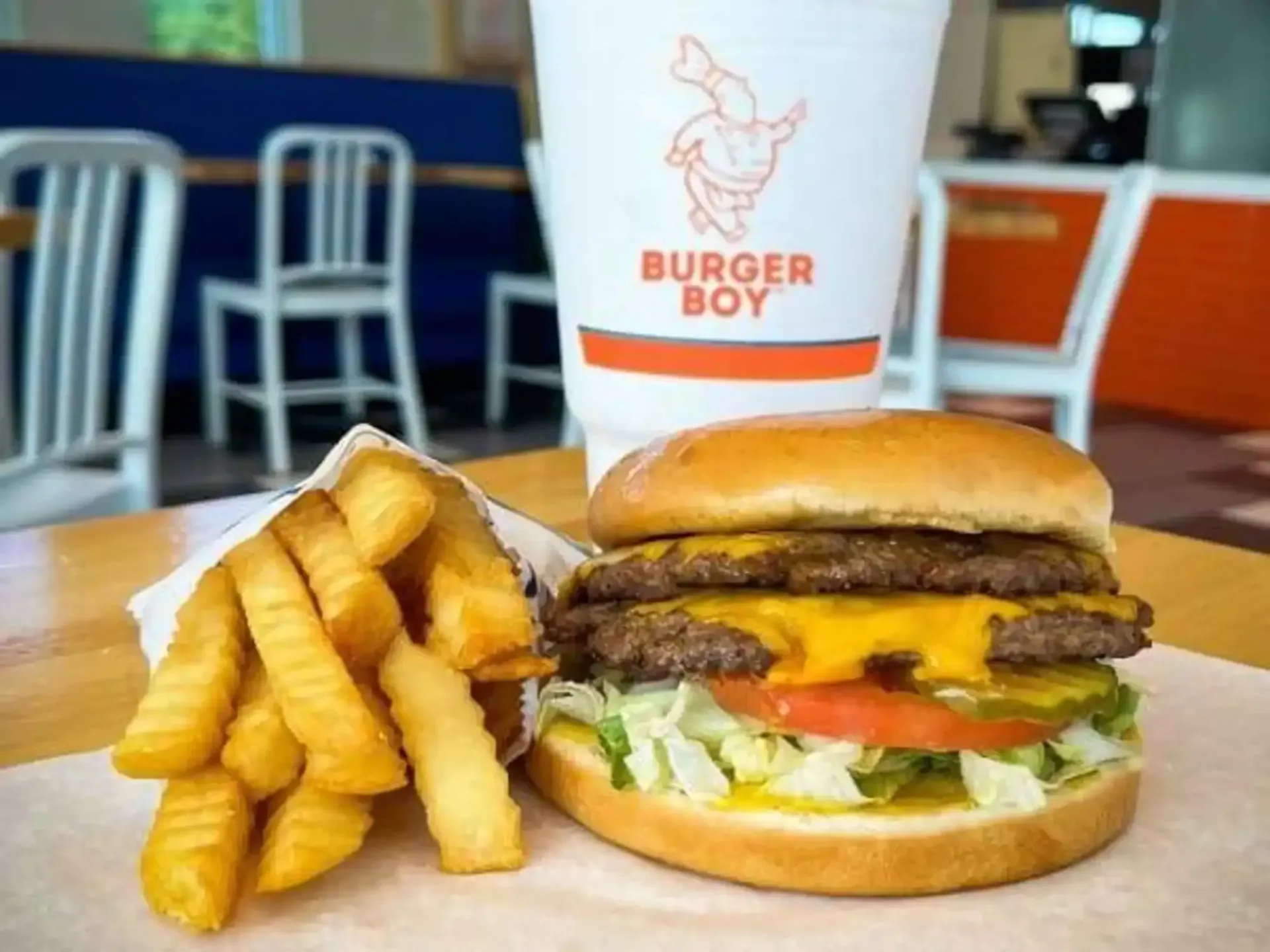
Burger Boy. I will make no attempt at journalistic neutrality here. Burger Boy is my one of my favorite burgers in San Antonio. Others include Chris Madrid's, Mr. Juicy (only have been once), Candy's (so good!), Tycoon Flats (so good!), Last Place Burger truck, Longhorn Cafe (so good!), and I've heard amazing things about Diana's. Burger Boy proudly describes itself as "born and raised in San Antonio," and despite growing to multiple locations, it retains the wonderfully uncomplicated DNA of the original: burger, fries, shake. No tweezers. No edible flowers. No dissertation from the server explaining the provenance of the sesame seed. Just give me a Working Man and let me live my life. Supporting local does not always have to mean a $150 dinner. Sometimes it's a burger.
The beer.
San Antonio's independent breweries deserve their own category because breweries may be one of the clearest examples of how a local business becomes a community.
Künstler Brewing has long been one of those places for us: distinctly San Antonio, neighborhood-oriented and built around the simple pleasure of sitting down over a beer. And Roadmap Brewing Co. has intentionally embraced that same taproom-first mentality. Years ago, owner Dustin Baker wrote that Roadmap wasn't interested in becoming enormous or putting beer in every store around town. The taproom—and the community within it—was the point. Today it has expanded the experience to include morning coffee while continuing to brew and serve beer throughout the day. Often, you'll run into somebody you know and trivia Tuesdays are a thing. Last Place Burgers food truck is a permanent fixture. Runners meets there. Yogis do too. A nonprofit holds an event. Somebody brings a dog. Somebody brings a baby. Somebody who moved here six months ago slowly becomes a regular.
Eventually, it's no longer just somewhere that sells beer. It becomes part of the infrastructure of a neighborhood.
Some other good spots include Back Unturned, Alamo, the new Austin-based Pinthouse, Beethoven (which doesn't brew beer but is a great local place to grab a pint or four), Breakaway, Black Lab, Southerleigh, and more.
Are chain restaurants bad?
No, and I think the conversation around eating locally gets less useful when we pretend they are. Chain restaurants employ local people. Their employees spend wages locally. Their locations pay property and sales taxes. They provide entry-level jobs, management careers and often benefits that a five-table restaurant simply cannot offer.
They also provide something consumers legitimately value: consistency. There are nights when you're traveling and you don't want an adventure. You want to know exactly what that bowl, burger, steak or plate of chicken is going to taste like. Chains can also provide affordable options for families, accommodate groups, stay open later and locate in parts of a city where opening an independent restaurant may carry considerably more risk.
Then there's this question: What exactly counts as "local?" Take Piatti, another restaurant we love. Piatti isn't an independently owned San Antonio restaurant; it has locations in several states. But its got an extremely local vibe with the two restaurants in town acting like their own independent shop. San Antonio restaurants employ San Antonians, serve San Antonio guests and are designed to function as neighborhood gathering places. The company explicitly encourages its chefs and managers to personalize individual restaurants to their communities.
So this shouldn't become a purity test. I don't intend to stop eating at every chain restaurant. I don't think anyone needs to. The question I'm becoming more interested in is balance. If we're going to spend $75 taking the family to dinner anyway, could one of those dinners this month be at a locally owned restaurant?
-Could we meet friends at Roadmap instead of a national beer chain?
-Could we buy the pizza from Il Forno?
-Could we try that tiny restaurant we've driven past fifty times?
-Could we get the burger from Burger Boy?
-Could we make a reservation at the independent restaurant whose Instagram posts we've been liking for six months without ever actually walking through its doors?
A "like" doesn't pay payroll. Dinner does. We get to decide what survives. Cities lose their character slowly. One restaurant closes, then another. The beloved bakery disappears. A neighborhood bar goes dark. The chef who was trying something interesting decides the economics no longer work. Eventually we wonder why every highway exit looks exactly like every other highway exit in America.
San Antonio has something worth protecting. We are one of only two UNESCO Creative Cities of Gastronomy in the United States. Food here isn't merely an amenity for tourists. It tells the story of migration, geography, agriculture, family, culture and generations of people cooking for one another.
A designation can't preserve that.Customers do -- we do. Every restaurant doesn't have to survive forever. Some concepts simply don't work. Businesses change. Owners retire. Diners' tastes evolve. That's part of a healthy food culture too. But the restaurants we claim to love need more than our affection. They need our business.
Go somewhere local this week. Sit at the bar. Order the appetizer. Tip the server. Have another beer if someone else is driving. Bring your friends. Tell somebody when the meal is great. Leave the review. Buy the gift card. Become a regular. Because eating locally is about more than keeping money in San Antonio.
It's about keeping San Antonio in San Antonio. And I'd very much like to keep it that way.
the eat. drink. life. chronicles