
FUNDAMENTALS OF BAKING
An introduction to some of the most essential bakes in the bakeshop.
01
02
03
04
05
06
01. COOKIES & QUICK BREADS
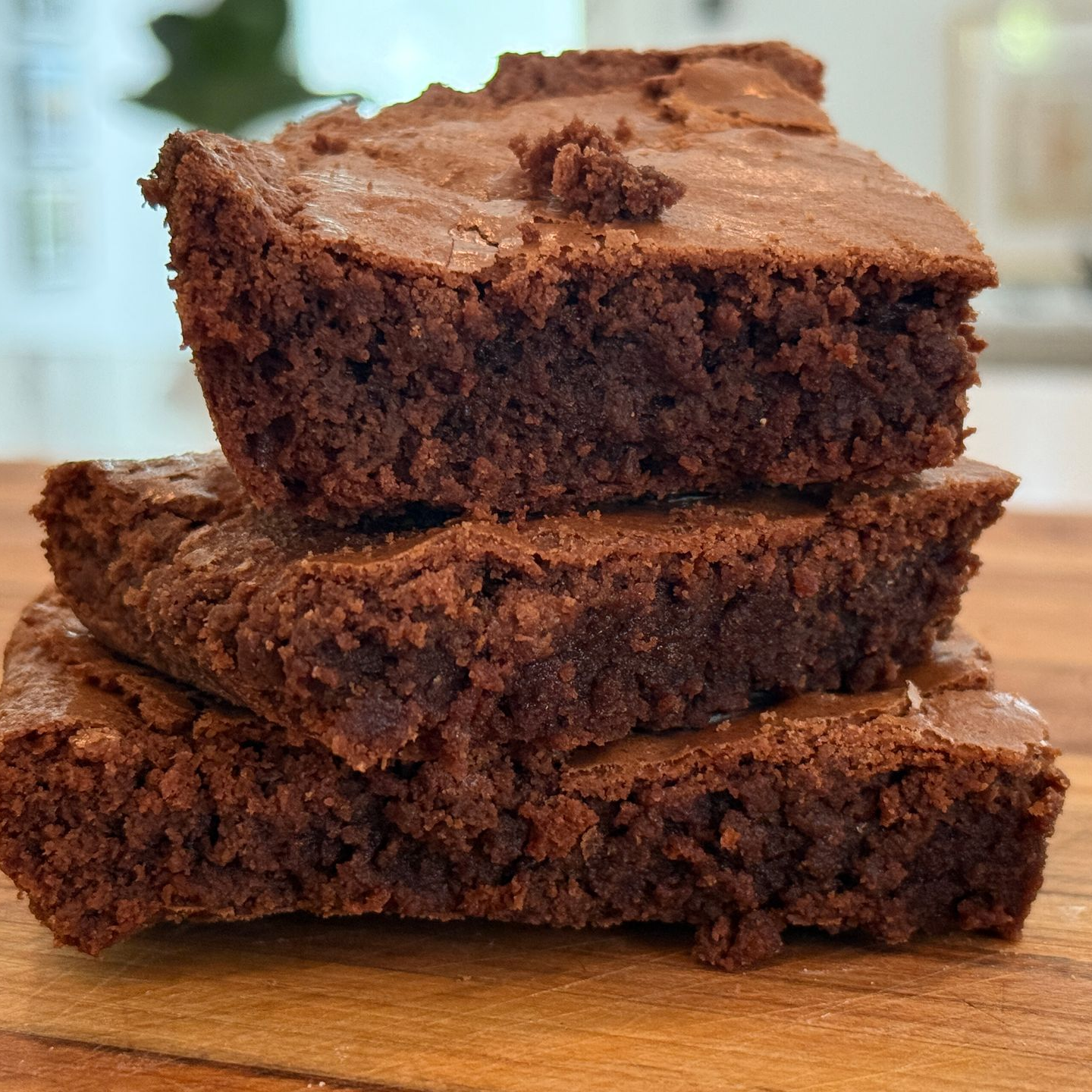
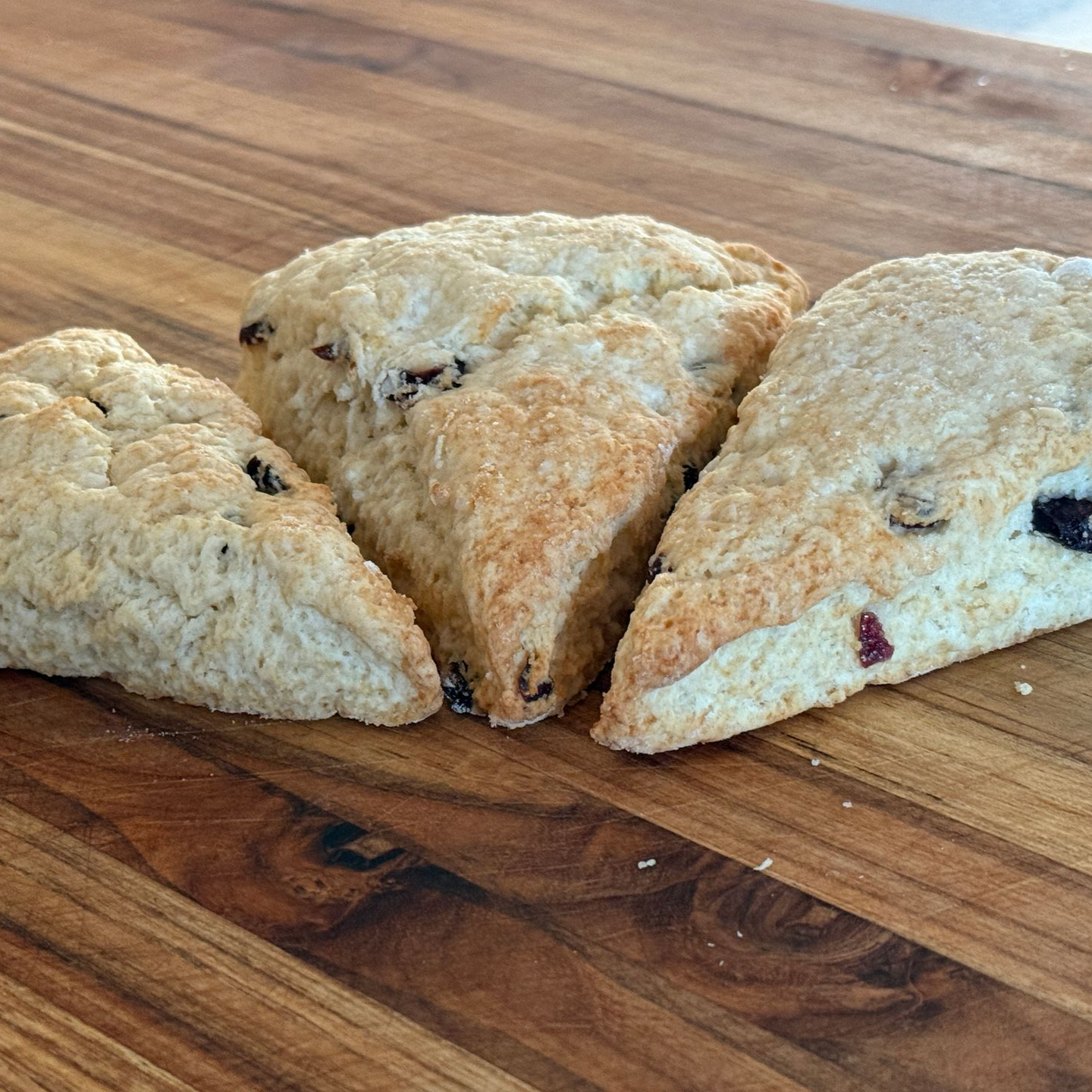
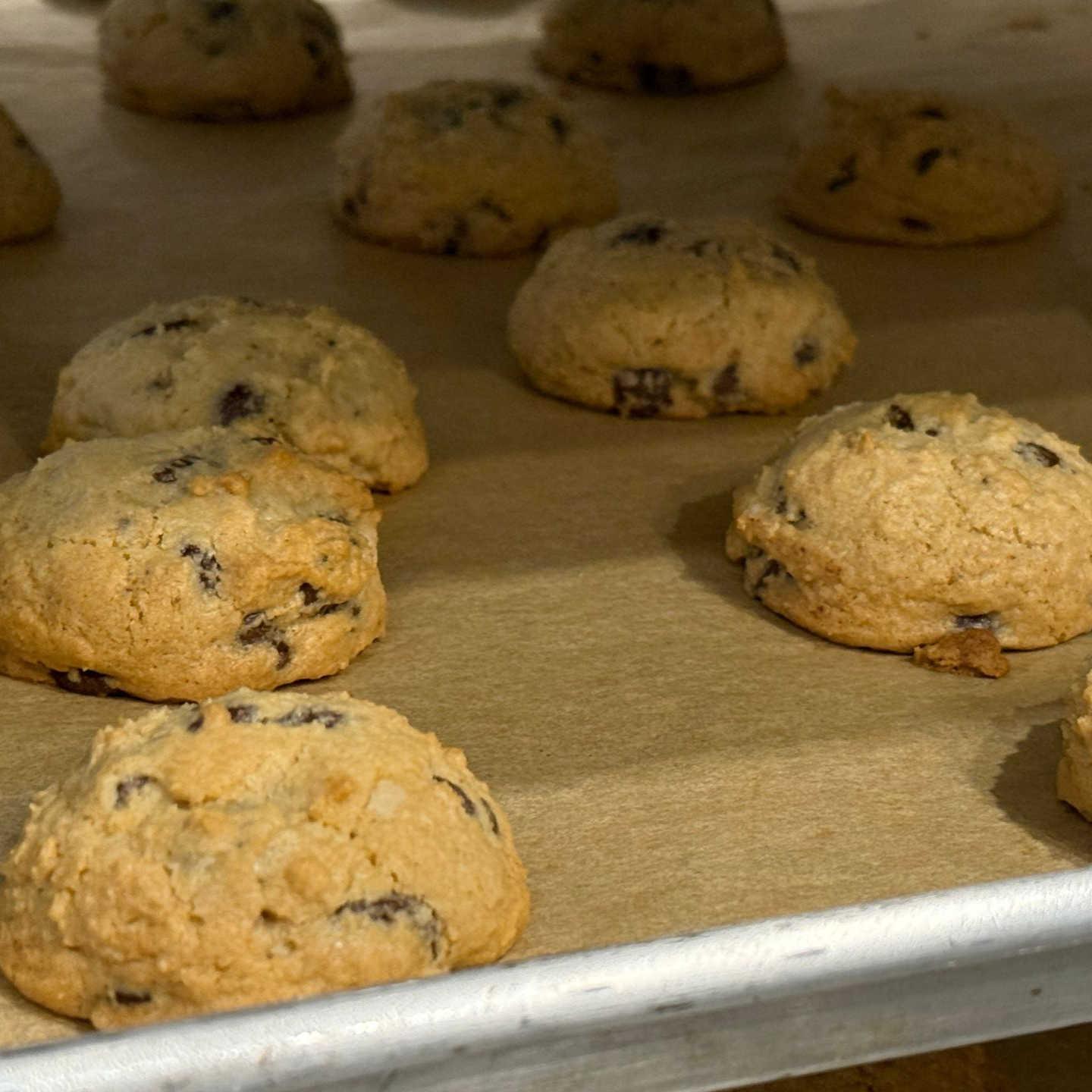
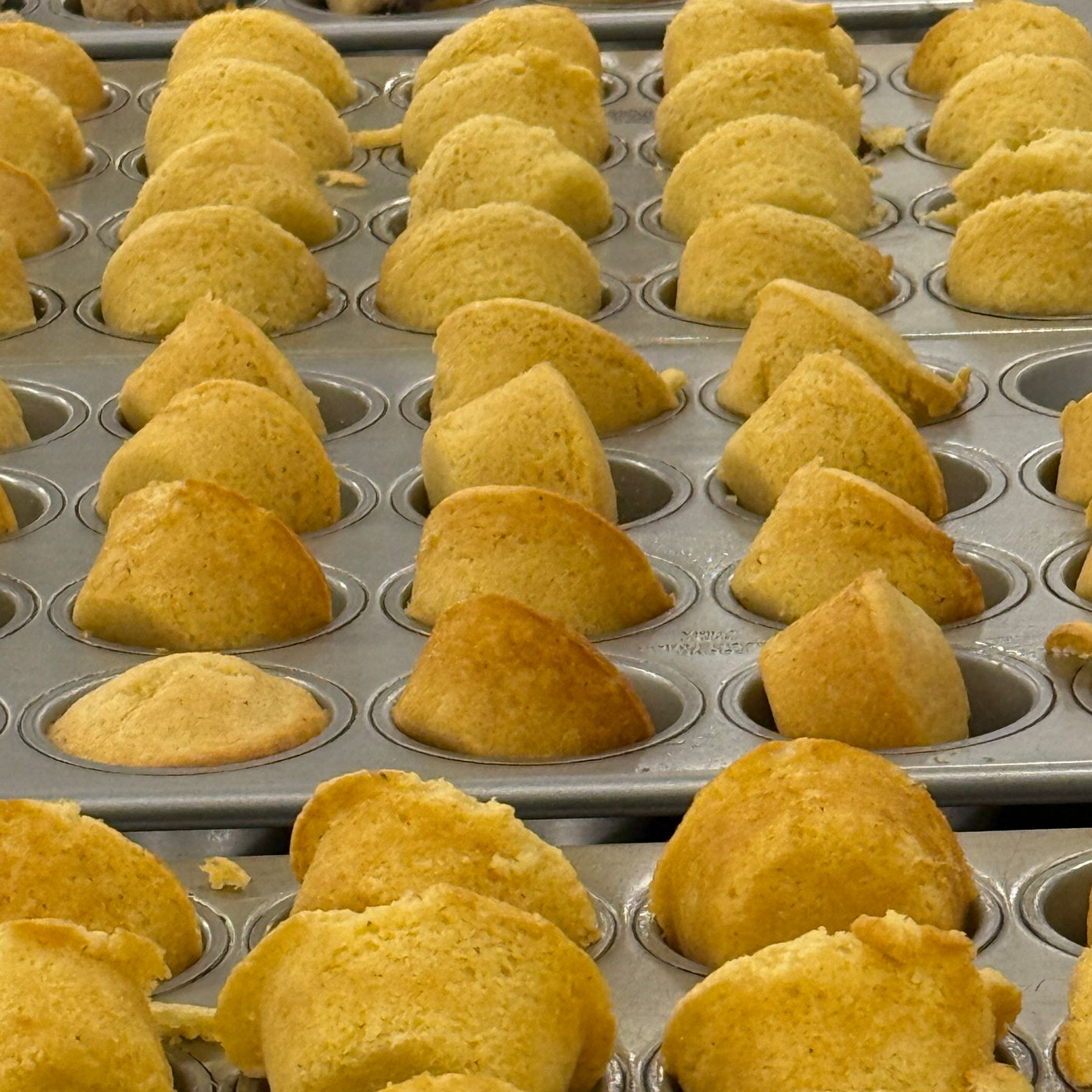
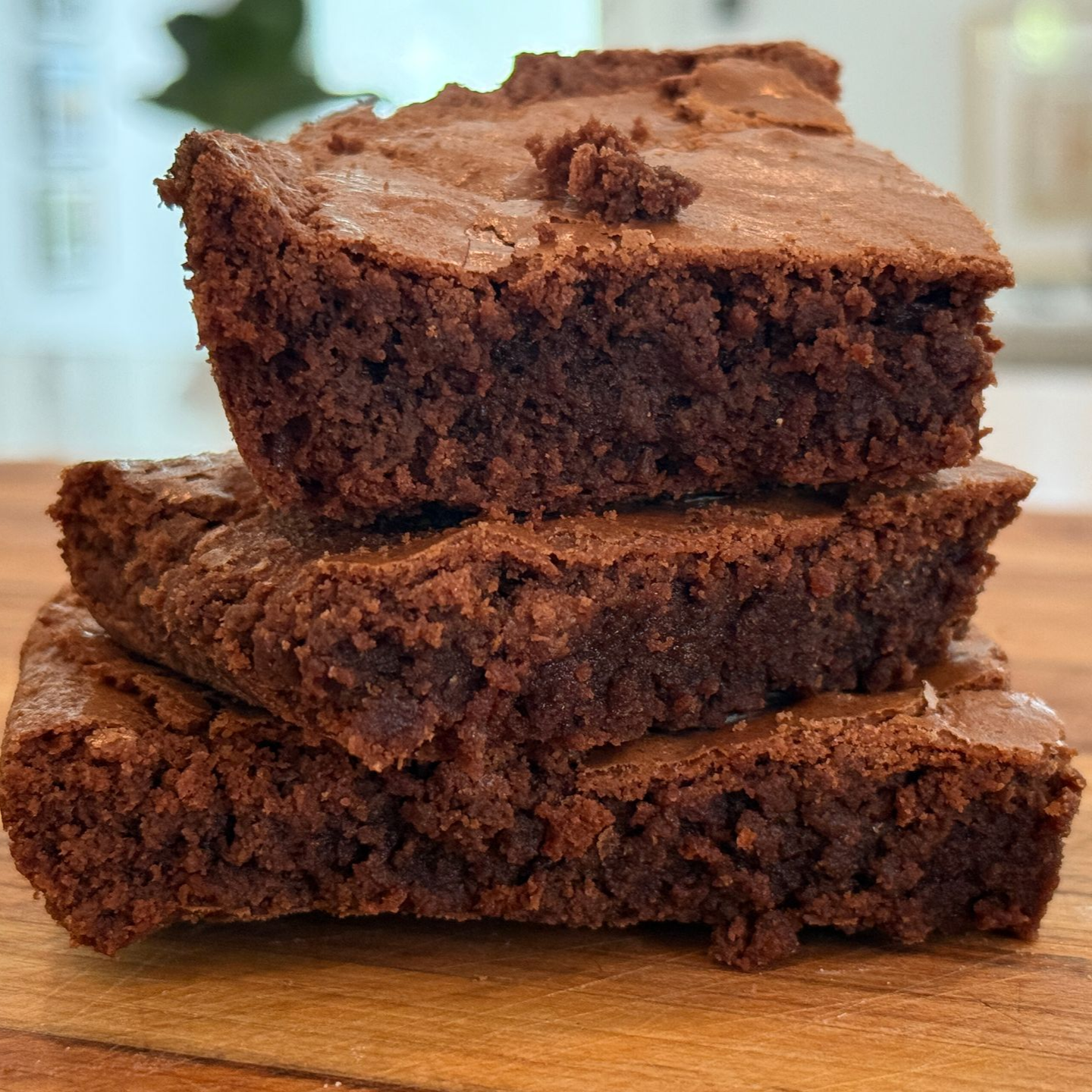
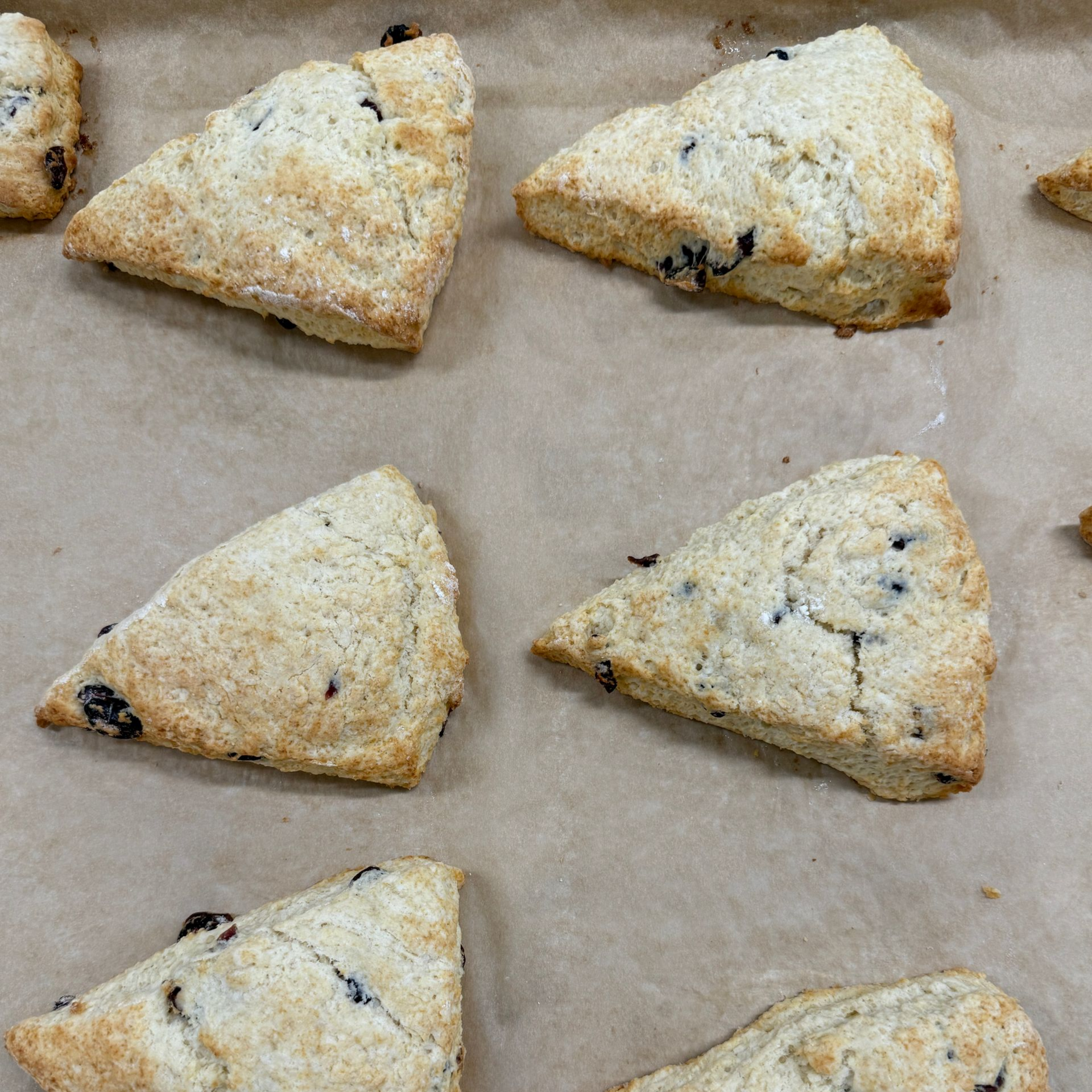
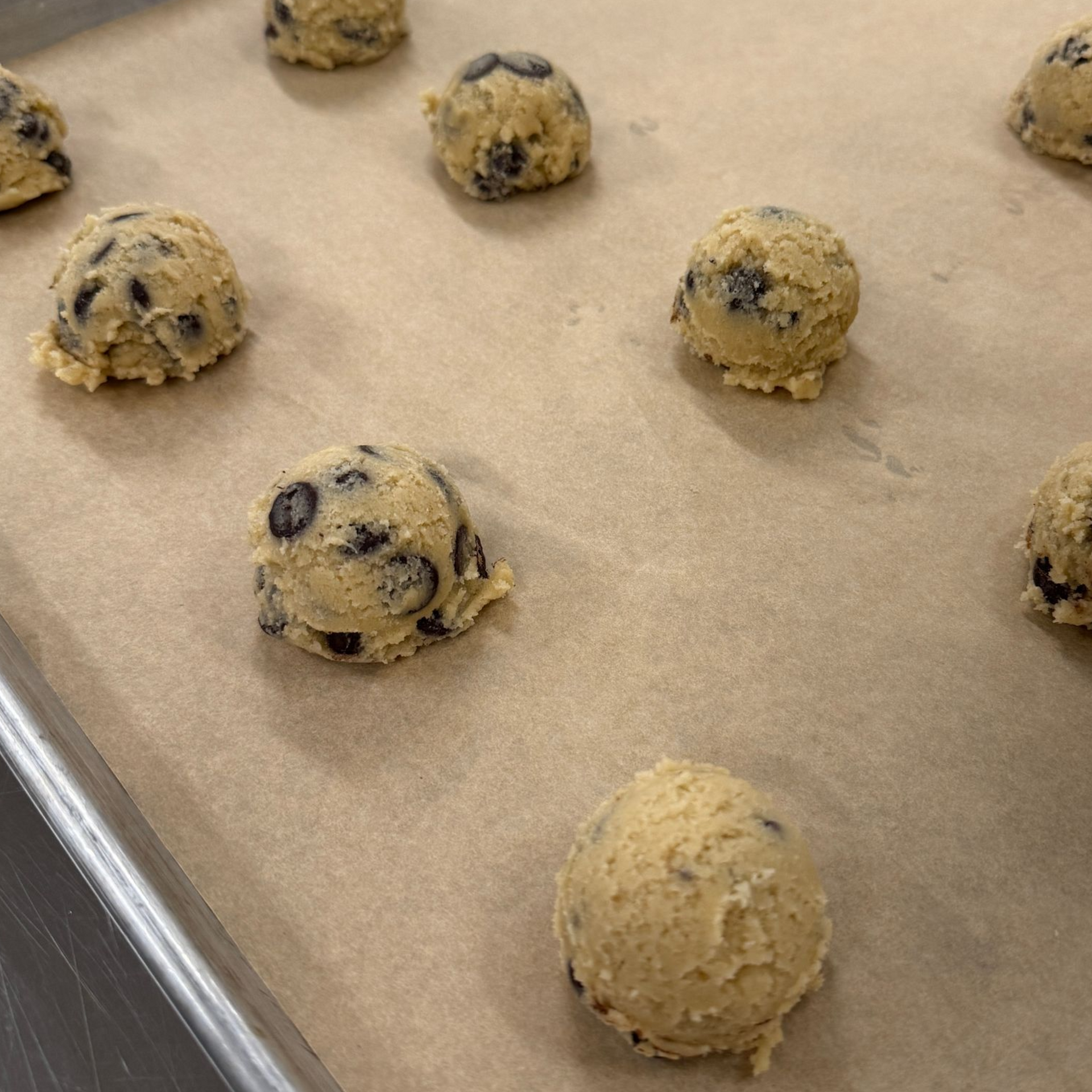
From chocolate chips cookies to brownies, scones, spritz cookies oatmeal raisin, corn bread, blueberry muffins and buttermilk biscuits, quick breads have the advantage of being easy to make in almost unlimited varieties.
Baker's Percentage
Calculations: Repeat for each ingredient
1. Convert ALL weights to ounces.
2. To calculate new flour weight:
NEW YIELD (OZ) / TOTAL % YIELD
= NEW FLOUR WEIGHT
3. To calculate new ingredient weight:
NEW FLOUR WEIGHT (OZ.) X INGRED. %
= NEW INGREDIENT WEIGHT (OZ)
To find the percentages when you have weights:
Formula:
Weight of ingredient / Weight Of Flour = ______ X 100 = (% of ingredient)
Example: Flour 10 oz.
Water 5 oz.
10oz / 10oz = 1.00 X 100 = 100%
5oz / 10oz = .50 X 100 =50%
Hint: Always move the decimal right two spaces to find the %.
To figure out new ingredient weights when you only have ingredient %’s
Tip: Must decide on flour weight, then calculate the rest of ingredients or must decide your new desired total yield and figure new flour weight
Formula:
New Flour Weight (oz.) X Ingredient % =
New Ingredient Weight (oz.)
Example: New Flour Wt. - 20 oz.
New Flour Wt. X Ingredient % (in decimal form) =
New Ingredient Wt. (oz.)
flour - 100% 20 oz. X 100% or (1.0) = 20 oz.
water - 60% 20 oz. X 60% or (.60) = 12 oz.
salt - 2% 20 oz. X 2% or (.02) = 0.4 oz.
yeast - 1% 20 oz. X 1% or (.01) = 0.2 oz.
- Flour
- There are four basic types of flour traditionally used in a bakeshop.
- Bread Flour: made from hard wheat with enough quality gluten to make it ideal for yeast breads. High protein count of 11 to 13.5%.
- All-Purpose Flour (also known as AP): A general purpose flour with a protein count of 10 to 11.5%. It is formulated to be slightly weaker so it can be used for pastries as well.
- Pastry Flour: It is a weak or low-gluten flour. Pastry flour is used for pie doughs and some cookies, biscuits, and muffins. It has a protein count of 9%.
- Cake Flour: weak or low-gluten flour with a soft smooth texture. Primarily used for cakes and delicate baked goods. It has a protein content of 8%.
- Additionally there is Self-Rising Flour. This flour contains baking powder, sometimes salt. It is limited by two factors.
Not all recipes call for baking powder. Baking powder loses its leavening power over time.
- Flour provides the bulk of the structure in a product, the amount you use can alter the texture.
- Example: A small amount of flour compared to butter (a ratio of 1 to 1 or less) will give you cookies that spread out into a wafer-like lace cookie. Extra flour (a ratio of 1.3 to 1 or higher) will give you cookies that barely spread at all as they bake, with centers that stay dense and dough-like, even after being almost fully cooked.
- More Bread Flour = Chewier Cookies / More Cake Flour = Softer Cookies
- Eggs
- Egg whites: They provide a good amount of water, as well as protein. Egg proteins are particularly good at trapping and retaining bubbles of air or water vapor. The higher the proportion of egg white in a product, the more it rises during baking. Because of the extra water, you also get more gluten formation. Other than the small amount in the butter, eggs are the main source of water in a recipe.
- Egg yolks: They provide some moisture and protein, but more importantly they provide a well-emulsified source of fat. When cooked, egg yolk forms a tender protein coagulum that can keep products tender.
- Example:
- Egg Whites = Taller Cookies / Egg Yolks = Fudgier Cookies
- By keeping the total mass of egg added to a dough the same but altering the proportion of white to yolk, you can achieve a variety of textures. Two whites and a yolk, for instance, produces the more open structure of the cookie, while three yolks and no whites produce the denser, fudgier texture of the cookie on the bottom.
- Typically, the 1 egg white to 1 egg yolk ratio is a consistent ratio to use
- Leavening—the introduction of air to the internal structure of baked goods—can come in many forms. In bread, it's the carbon dioxide produced by yeast. In a cream puff, it comes from expanding water vapor. In the case of cookies, we get it from egg proteins capturing expanding gases, creamed butter, and most importantly, chemicals, namely baking powder and baking soda.
- What's the difference between the two?
- Baking Soda: Pure sodium bicarbonate—an alkaline powder (aka, a base). When dissolved in liquid and combined with an acid, it rapidly reacts, breaking down into sodium, water, and carbon dioxide.
- Baking Powder: It is baking soda with powdered acids built right in. In its dry state, it's totally inert. But once you add a liquid, the powdered acid and base dissolve and react with each other, creating bubbles of carbon dioxide without the need for an external acid source. Most baking powders these days are double acting, which means that it contains two different powdered acids. One that reacts immediately upon mixing with water, and another that only reacts after it's heated, giving cakes and cookies a little boost early in the baking phase
- Temperature
- Never underestimate the importance of controlling temperatures, beginning with raw ingredients to finished products
- Be mindful; ingredients change properties with temperature
- Practice tempering when introducing ingredients of two widely different temperatures or when bringing an ingredient from one extreme temperature to another
- Tempering ingredients together can avoid curdling in egg and milk products and tiny rubbery balls in gelatin products
- Example: When baked at a lower temperature, cookie dough has more of a chance to spread out, leading to flatter, wider cookies. Conversely, cookies baked at higher temperatures spread less. Even a difference of as little as 50°F makes a big difference.
- Cooler Oven = Wide Cookies / Hotter Oven = Compact Cookies
- Warmer Dough = Wide Cookies / Cooler Dough = Compact Cookies
Quick Breads
- Prepare muffins, loaf breads or tea breads, coffee cakes, and corn breads
- Prepare baking powder biscuits and variations of them
Quick breads are perfect for food service operations that want to offer fresh, homemade bread products but can't justify the labor cost of making yeast breads. Quick breads are quick to make. They are leavened by chemical leaveners and steam, not by yeast. No fermentation time is necessary. They have little gluten development. They are tender products and mixing them takes a few minutes.
Cakes are among the richest and sweetest of baked goods, offering a delightful treat that many people savor on special occasions and everyday celebrations alike. Making a cake requires a level of precision that is akin to bread-making, though for different reasons and techniques. High in fat and sugar, cakes demand careful attention from the baker, who must skillfully create a structure that not only supports these rich ingredients but also maintains a light and delicate texture that melts in the mouth. This balance of science and art transforms simple elements like flour, eggs, and butter into a delicious confections that can evoke joy and nostalgia with every bite.
Cakes are among the richest and sweetest of baked goods, offering a delightful treat that many people savor on special occasions and everyday celebrations alike. Making a cake requires a level of precision that is akin to bread-making, though for different reasons and techniques. High in fat and sugar, cakes demand careful attention from the baker, who must skillfully create a structure that not only supports these rich ingredients but also maintains a light and delicate texture that melts in the mouth. This balance of science and art transforms simple elements like flour, eggs, and butter into a delicious confections that can evoke joy and nostalgia with every bite.
Mixing Methods
Muffin Method: Used for muffins, pancakes, waffles, and many loaf-type or sheet-type quick breads. The danger is that the dough can become over mixed.
- Sift dry ingredients
- Combine all liquid ingredients, including melted fat or oil
- Add the liquids to the dry ingredients and mix until all the flour is moistened. The battery will look lumpy. Don't over mix
- Pan and bake right away
Creaming Method: The most common mixing method in the bakeshop. A cake-mixing method that is sometimes applied to muffins and loaf breads. There's no dividing line between muffin products and cakes, but if they are rich enough, muffin products may be considered cakes rather than breads.
- Combine the fat, sugar, salt, spices and milk powder if used in the bowl of a mixer fitted with the paddle attachment.
- Cream the ingredients together until light
- Add the eggs in two or three stages. Cream well after each addition
- Sift together the flour, baking powder, and other dry ingredients
- Stir together the liquid ingredients until well combined
- Add the sifted dry ingredients alternately with the liquids - add 1/4 of the dry ingredients and mix until blended; add a 1/3 of the liquid and mix until blended; repeat until all ingredients are used. Scrape down the sides of the bowl occasionally for even mixing
Biscuit Method: Used for biscuits, scones, and similar products. Sometimes called the pastry method because it's the same for mixing pie pastry. Biscuit dough is often lightly kneaded, enough to help develop some flakiness but not so much to toughen it. Biscuit dough that has been lightly kneaded rises more than dough that has not been kneaded. Unkneaded dough spreads more than kneaded dough and has a more cake-like texture.
Some biscuits are mixed by the creaming method which result in more cake-like texture and is less flaky. Fat and sugar for creamed biscuit dough should be mixed only until just combined.
- Scale all ingredients.
- Sift the dry ingredients together in a mixing bowl.
- Cut in the shortening using the paddle attachment or the pastry knife attachment, or cut in the fat by hand using your fingers or pastry blender. Continue until the mixture resembles cornmeal.
- Combine the liquid ingredients.
- Add the liquid to the dry ingredients. Mix until combined and a soft dough is formed. Don't over mix.
- Bring the dough to the bench, knead lightly by pressing it out and folding it in half. Rotate 90 degrees between folds.
- Repeat 6-10 times. The dough should be soft and elastic but not sticky. Overkneading toughens the biscuits.
Variations:
Changes in basic procedure produce different characteristics in the finished product. You can use slightly more shortening, and cut in less-only until the pieces are the size of peas-produces a flakier biscuit or omit the kneading step which produces a very tender, crusty biscuit with less height.
Cookies
- Describe causes of crispiness, softness, chewiness, and spread in cookies
- Prepare cookie doughs by using the four basic mixing methods
- Prepare eight types of cookies: Dropped, bagged, rolled, molded, icebox, bar, sheet, and stencil
- Bake and cool cookies properly
- Explain how to judge the quality of cookies and correct defects in them
The word cookie means "small cake," and that's what a cookie is. Some cookies are even made from cake batter. For some products like brownies, it's difficult to know whether to classify them as cakes or cookies. Cookies call for less liquid than cake formulas.
Cookies come in all shapes and sizes, flavors and textures. Some cookies are meant to be soft, some crispy, some chewy. Crispiness is achieved when cookies are low in moisture. Factors like high sugar and fat, baking long enough to evaporate most of the moisture, convection ovens that dry cookies more quickly, small or thin shape, and proper storage. Softness has the opposite causes: high proportion of liquid in the mix, low sugar and fat, honey, molasses, or corn syrup included in the formulas (they are hygroscopic, which means they readily absorb moisture from the air or from their surroundings), underbaking, large or thick shape, and proper storage. Chewiness involves moisture in the cookie, meaning that all chewy cookies are soft, but not all soft cookies are chewy. These factors contribute to chewiness: high sugar and liquid content, but low fat content, high proportion of eggs, strong flour or gluten development during mixing.
Spread is desirable in some cookies, and others hold their shape. Factors contribute to spread or the lack of it.
- High sugar content increases spread. Course granulated sugar increases spread, while fine sugar or confectioners' sugar reduces spread
- High baking soda or baking ammonia content encourages spread
- The creaming together of fat and sugar contributes to leavening by incorporating air; creaming a mixture until light increases spread but blending fat and sugar just to a paste without creaming in a lot of air reduces spread
- Low oven temps increase spread; high temps decrease spread because the cookie sets up before it has a chance to spread too much
- A slack batter, one with high liquid content, spreads more than stiff dough
- Strong flour or activation of gluten decreases spread
- Cookies spread more when baked on heavily greased pans
Cookie mixing methods are like those for cakes. The difference is that less liquid is usually incorporated, so mixing is easier. Four basic cookie mixing methods are: One-stage, creaming, sanding (sablage), and sponge.
One-stage is not frequently used because the baker doesn't have a lot of control over it because all the ingredients are mixed at once.
Creaming method is nearly identical to that of cakes, but it's not necessary to add the liquid alternately with the flour. It can be added all at once.
Sanding or sablage is a mixing method for rich tart pastries and pâte brisée. The two basic steps of this method include mixing the dry ingredients with fat until the mixture resembles sand or cornmeal, and mixing in the moist ingredients. This method is used mainly for formulas that contain only egg and no other moist ingredient.
Sponge method for cookies is similar to the egg-foam methods for cakes. The procedure varies depending on the ingredients. Batches should be kept small because the batter is delicate. To mix, scale and have all ingredients at room temp. Whip the eggs-whole, yolks, or whites, and the sugar to the proper stage... soft peaks for whites, thick and light for whole eggs or yolks. Fold int he rest of the ingredients. Don't over mix.
When you bake a cookie, here’s what’s going on, step by step:
-The dough spreads. As the butter warms, it slackens. The cookie dough begins to turn more liquid and gradually spreads out.
-The edges set: As the cookie spreads, the edges thin out. This, coupled with the fact that they are fully exposed to the heat of the oven and are constantly reaching hotter areas of the baking pan, causes them to begin to set long before the center of the cookie does.
-The cookie rises: As the butter melts and the cookie's structure loosens, this frees up water, which in turn dissolves baking soda. This baking soda is then able to react with the acidic components of brown sugar, creating gases that cause the cookies to rise up and develop a more open interior structure.
-Egg proteins and starches set: Once they get hot enough, egg proteins and hydrated starches will begin to set in structure, finalizing the shape and size of the finished cookie.
-Sugar caramelizes: At its hottest areas—the edges and the underbelly in direct contact with the baking dish—sugar granules melt together, turning liquid before starting to caramelize and brown, producing rich, sweet flavors.
-The Maillard reaction occurs: Proteins in the flour and the eggs brown along with the sugar in a process called the Maillard reaction—the same reaction responsible for giving your hamburger or bread a brown crust. It produces nutty, savory, toasted flavors.
-Maillard Reaction: A chemical reaction that causes the browning of proteins and sugars together when subjected to heat.
-The cookie cools. Once it comes out of the oven, the process isn't over yet. Remember that liquefied sugar? Well as the cookie cools, that liquid sugar hardens up, which can give the cookie an extra-crisp, toffee-like texture around the edges. Meanwhile, the air inside cools, which causes the cookie to deflate slightly, though when fully baked, the structure lent by eggs and flour will help it retain some of its rise.
Extracts/spices: Vanilla most common and important. Extracts are oils/other substances dissolved in alcohol. Spices-plant or vegetable substances used to flavor foods. You can interchange extract/spice flavors. Salt balances flavor for caramelized sugars.
Recipes
02. CAKES
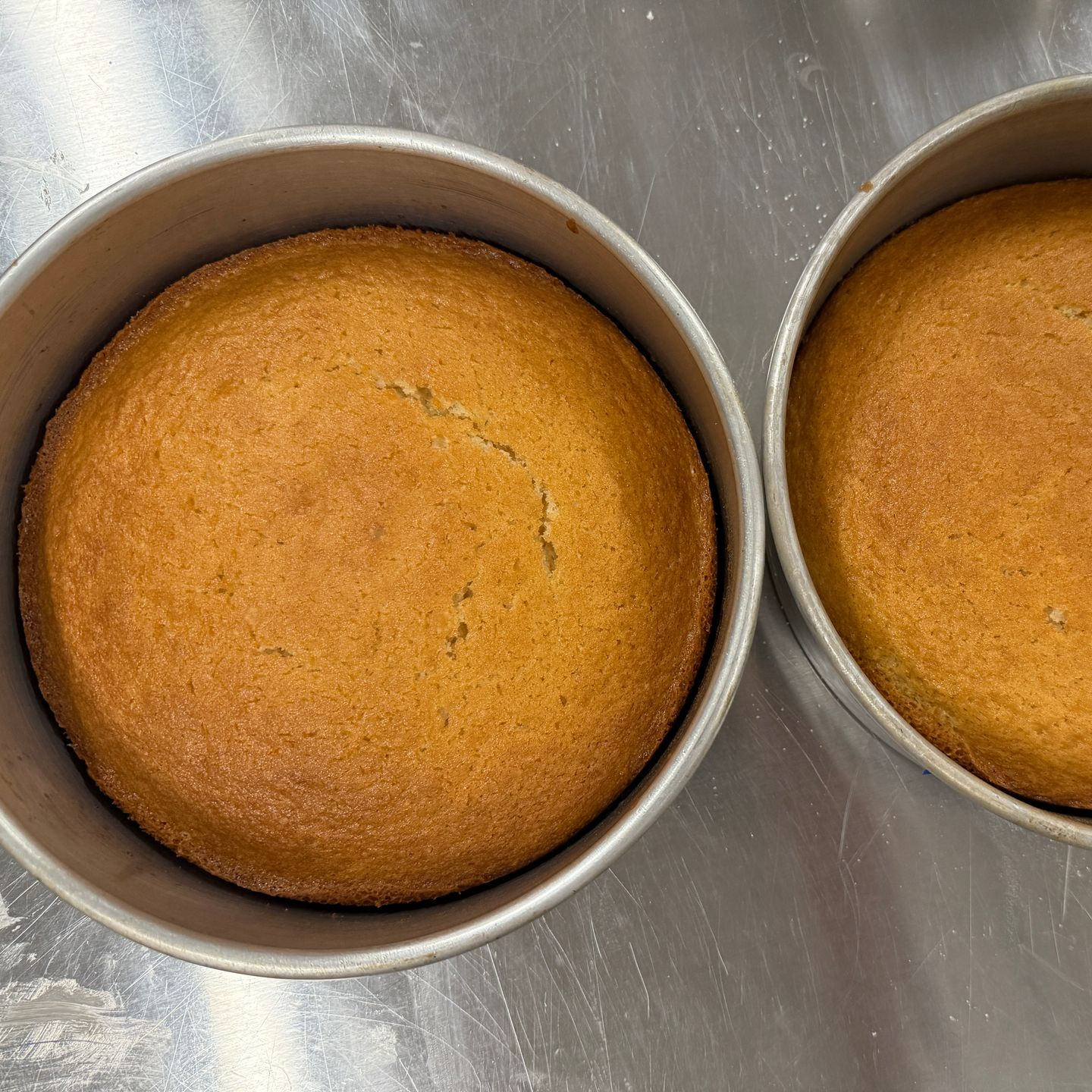
Cakes are among the richest and sweetest of baked goods, offering a delightful treat that many people savor on special occasions and everyday celebrations alike. Making a cake requires a level of precision that is akin to bread-making, though for different reasons and techniques. High in fat and sugar, cakes demand careful attention from the baker, who must skillfully create a structure that not only supports these rich ingredients but also maintains a light and delicate texture that melts in the mouth. This balance of science and art transforms simple elements like flour, eggs, and butter into a delicious confections that can evoke joy and nostalgia with every bite.
- Three goals to mixing cake batter:
- To combine all ingredients into a smooth, uniform batter. This is obtained by proper emulsion of fat and liquid, proper temperature of ingredients, speed of mixing, and the proper amount of ingredients.
- To form and incorporate air cells in the batter. Air cells are important for texture and leavening. Correct ingredient temperature and mixing speed.
- To develop the proper texture in the finished product. Proper gluten development will affect the texture. Maintaining the proper speed and how ingredients are incorporated will determine the final texture.
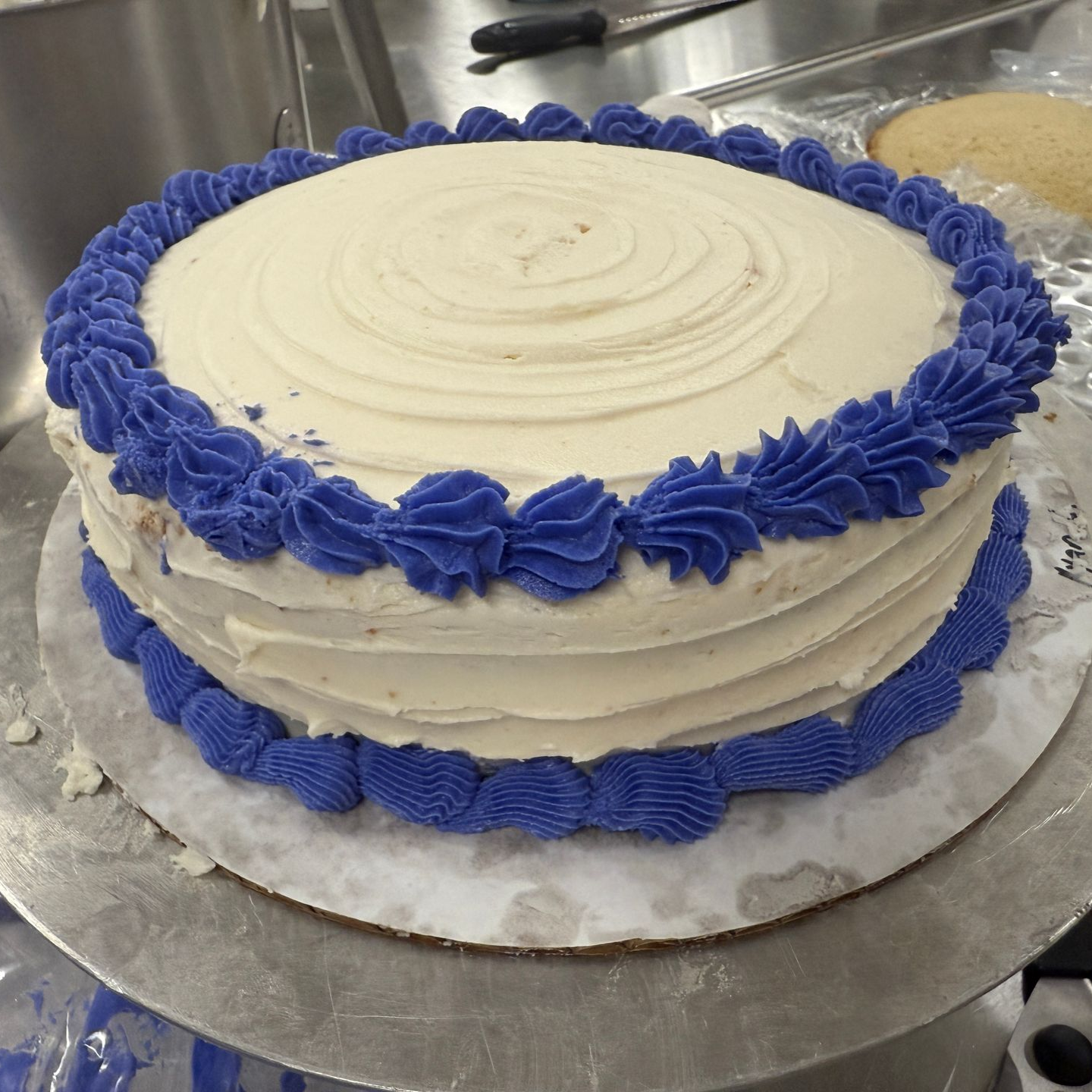
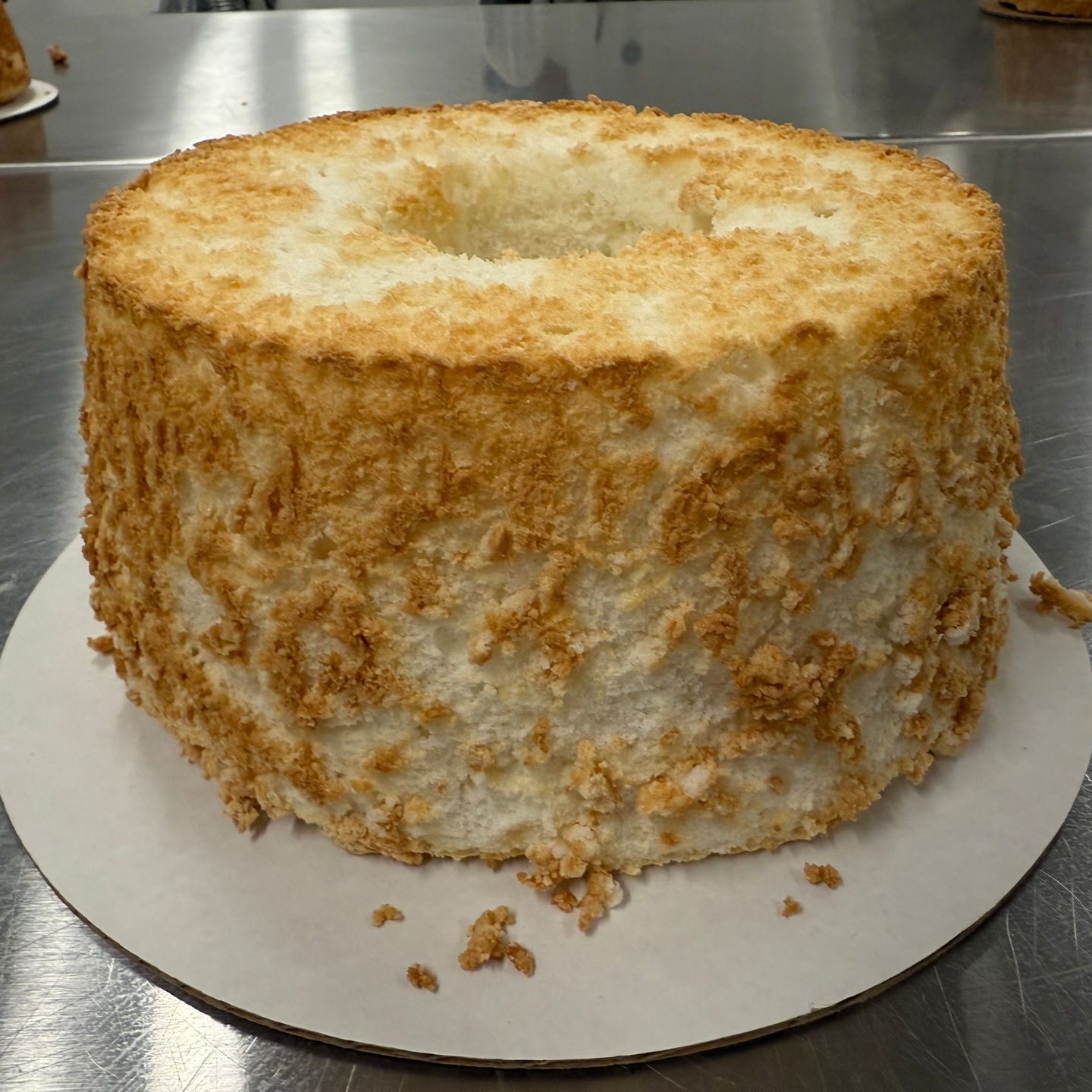
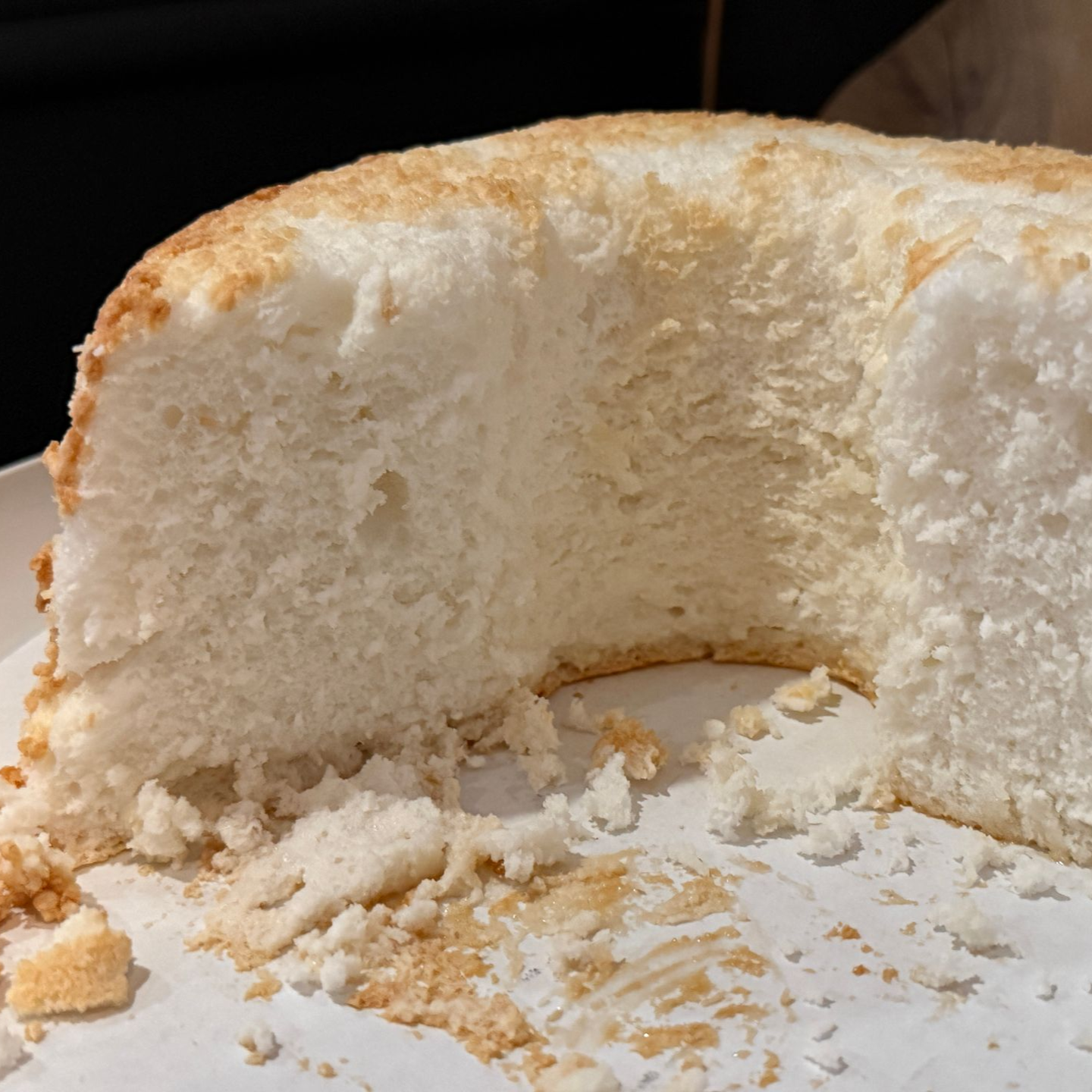
Six basic types of mixing methods used in cake making. The goal is to combine all ingredients into a smooth, uniform batter by proper emulsion of fat and liquid, proper temps of ingredients, proper mixing speeds, proper amount of ingredients; to form and incorporate air cells in the batter important for texture and leavening; to develop the proper texture in the finished product with proper gluten development, maintaining proper speed and how ingredients are incorporated will determine final texture.
- Creaming Method – creaming fat and sugar together to create a light and fluffy texture.
- Two Stage Method – high ratio cakes containing a large percentage of sugar, more than the 100% weight of flour. Made with more liquid than creaming method allowing batter to pour more freely.
- One Stage Method – High-ratio liquid shortening is emulsified and spread through the batter to tenderize gluten all mixed in one step.
- Egg-Foam Cakes (Sponge Method) – An egg-foam method that is used by using a whole egg, only egg yolks, or separating eggs and then folding them in together.
1. Basic Sponge Method – Made in two steps (1) Eggs and sugar are whipped to a thick foam, and (2) Sifted flour folded in
2. Angel Food Method – Egg white foam cake with NO fat. Egg whites are whipped to soft peaks, then a dry flour-sugar mixture is gently folded into egg whites. If overwhipped the whites will lose the capability to expand and leaven cake allowing for proteins to stretch more during the baking process.
3. Chiffon Method – A batter of flour, egg yolks, vegetable oil and water are folded into egg whites. Egg whites are whipped to a firm peak and rely on baking powder to aid in the leaving of batter.
Prepared Mixes or boxed mixes contain all ingredients except water and eggs. They contain emulsifiers to ensure even blending. Most often they will create excellent volume, texture, and tenderizers. Whether they are better than scratch cakes is left to the guinea pig.
Pan Prep: Prepare before mixing. High fat cakes: layer pans then spray and line with parchment or dust greased pans with flour and tap out excess. By spraying pan and lining with parchment, the cake will finish in a nice fluffy and tender cake. By only greasing and coating pan with flour, you will develop a tougher and caramelized outer shell which could hinder final texture. Sheet/chiffon cakes: line with greased parchment. For thin layer cakes, such as Swiss rolls, you must use a level pan without dents or warps. Angel food: DO NOT GREASE PAN. The batter must be able to cling to the sides, so it doesn’t sink back into the pan after rising. NOTE: The most ideal pan to use when baking Angel Food is aluminum. Nonstick also works. Scaling: For consistency in even layers of cake you should scale your pans by weight or volume. This is the most accurate method for all types of batters.
Testing for doneness: High fat cakes shrink away slightly from sides of pan; cake tester or wooden pick will come back with moist crumbs; cake is springy, then center of cake will spring back when pressed.
- Ingredient Temps:
- The temperature of the ingredients with play a large factor in creating a quality cake product.
- Butter should have an average temperature of around 65*. This temperature will keep it pliable and cool as it's beaten. At warmer temperatures, butter will lose its plasticity, making it too soft and squishy to fold over on itself and entrap air. Without air bubbles, butter and sugar form an ultra-dense paste that gives cakes the texture of a wet brick. But with cool ingredients, and a little patience, butter and sugar will indeed cream up as "fluffy and light.“
- Eggs should be added slowly and at room temperature. This will aid in the emulsion process.
- Other liquids should be a room temperature as well.
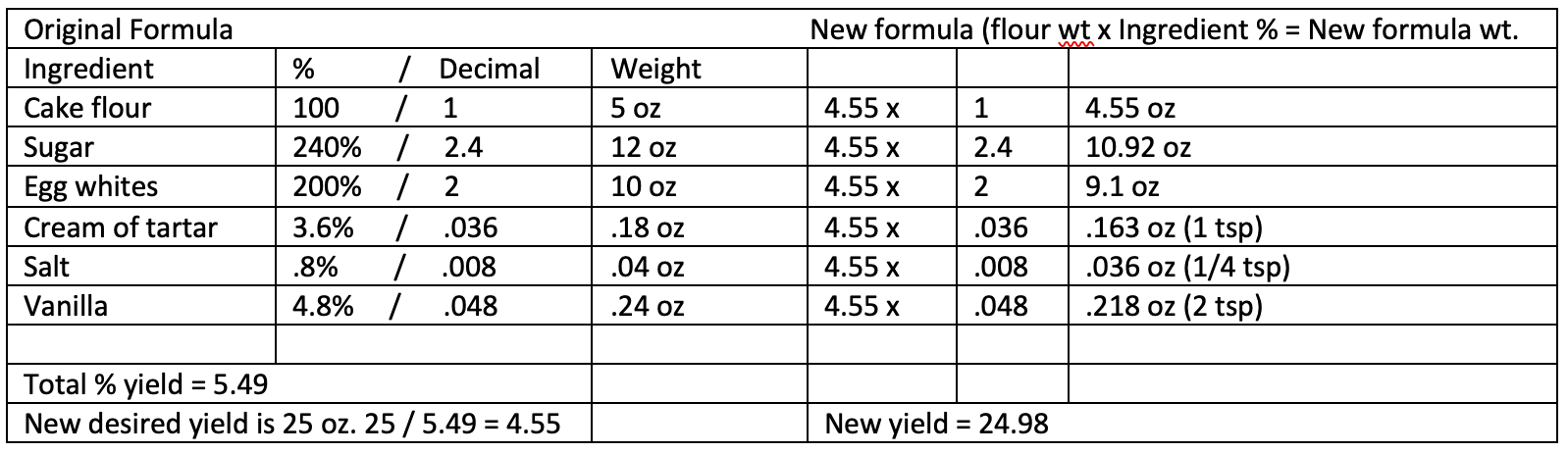
Baker’s %
Weight of ingredient = Decimal x 100 = %
Weight of flour
- Pan Prep:
- Always prepare pans before mixing cake batters.
- High fat cakes: layer pans then spray and line with parchment paper. If not available, dust greased pans with flour and tap out excess. NOTE: By spraying pan and lining with parchment paper the cake will finish in a nice fluffy and tender cake. By only greasing and coating pan with flour you will develop a tougher and caramelized outer shell with could hinder the final texture.
- Sheet/Chiffon cakes: line with greased parchment. For thin layer cakes, such as swiss rolls, you MUST use a level pan without dents or warps.
- Angel Food: DO NOT grease the pans. The batter must be able to cling to the sides, so it doesn’t sink back into the pan after rising. NOTE: The most ideal pan to use when baking an Angel Food cake is an aluminum pan. However, nonstick will work also.
- Scaling - For consistency in even layers of cake you should scale your pans by weight or volume. This is the most accurate method for all types of batters. However, this step is entirely left to the baker.
- Doneness:
- High fat cakes shrink away slightly from sides of pans.
- Cake tester or wooden pick will come back with moist crumbs.
- Cake is springy, then center of cake will spring back when pressed lightly.
Recipe: Set of instructions for producing a certain dish. Baker’s %: Indicate the amount of each ingredient used as a % of the amount of flour used. Flour is used as the basis bc it is the main ingredient in early all baked goods. Scone flour: British bakers have a method for measuring baking powder when small quantities are used. To make 1 lb, combine 15 oz flour with 1 oz baking powder, sift 3x. Pathogen: Microorganism that can cause a disease. Bacteria, viruses, fungi, parasites are 4 kinds of microorganisms that can contaminate food and cause illness. Allergen: A substance that triggers an allergic reaction. Critical Control Point (CCP): Action that can be taken to eliminate or minimize a food safety hazard. Flow of food: The path food travels in a food service operation, from receiving to serving. Formulas - Baker’s talk in formulas. The term formulas refer only to the list of ingredients and quantities. A standardized formula is a set of precise instructions describing the way an establishment prepares an item functions as quality and quantity controls. Instructional formulas are for teaching and cooking techniques purposes.
Recipes
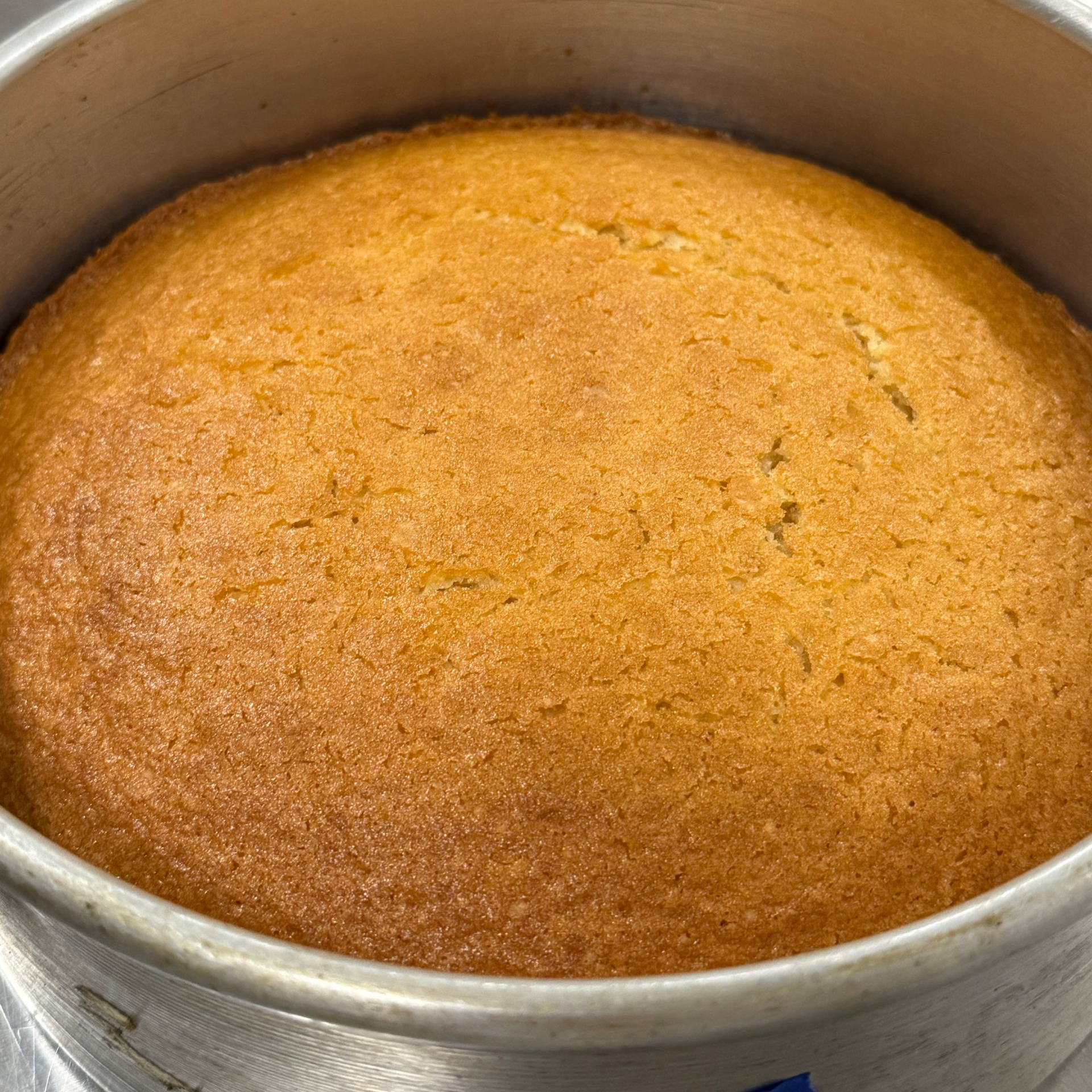
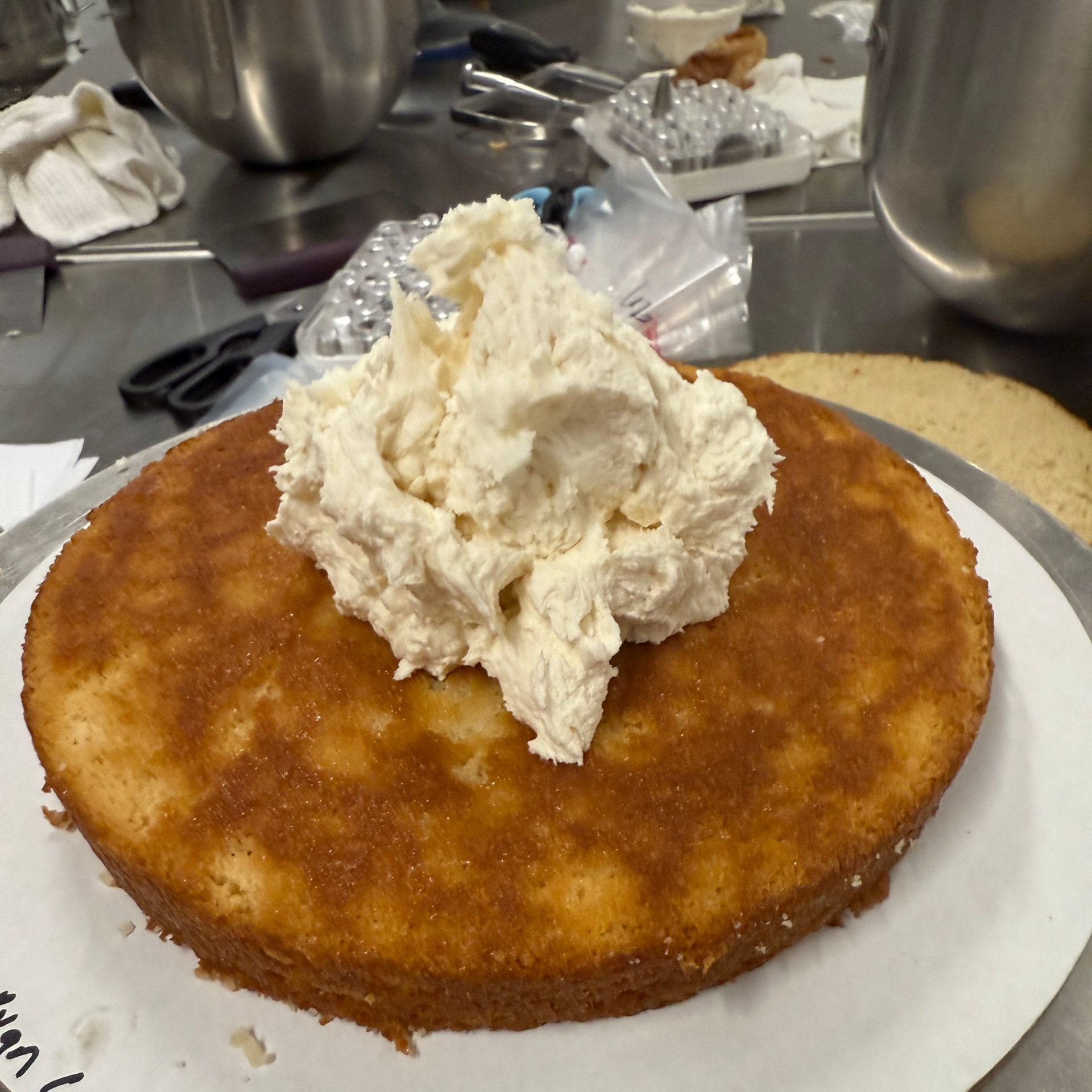
White Cake
Creaming method
Ingredients
- 13 oz AP flour
- 16 oz sugar
- 1 Tbsp/.5 oz baking powder
- 1 tsp/.16 oz salt
- 8 oz milk
- 4 oz vegetable oil
- 1 Tbsp/.5 oz vanilla
- 2 eggs each/1.67 oz each
- 4 oz water
Method
- Dry ingredients in mixing bowl.
- Combine milk, oil, vanilla, and eggs, mix in dry until just combined.
- Add water, mix until combined
- Bake in 350 degree F oven for large cakes.
Buttercream Icing
Ingredients
- 8 oz butter
- 8 oz shortening/cream cheese
- 32 oz powdered sugar
- Pint salt
- 2 tsp vanilla
- 1 Tbsp lemon juice
- 2 Tbsp heavy cream
Method
- Mix butter/shortening together on medium speed until creamy.
- Add powdered sugar in small batches until combined. Make sure to constantly scrape mixing bowl to ensure even mix.
- Add salt, vanilla, and lemon juice. Mix well.
- Add heavy cream, mix well.
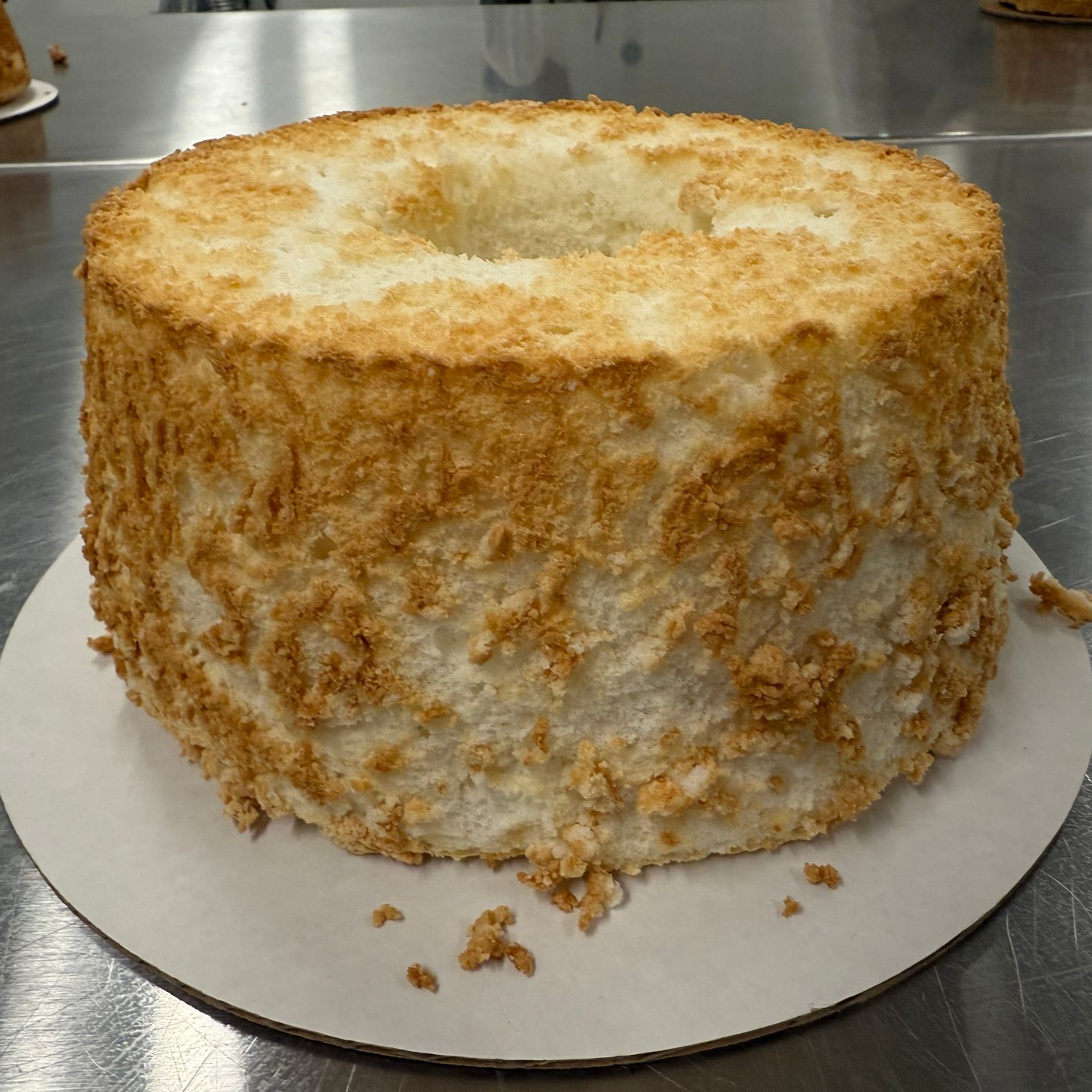
Angel Food Cake
Angel Food Method
New Yield: 25 oz
Ingredients
- 4.55 oz cake flour
- 10.92 oz sugar
- 9.1 oz egg whites (8-9 eggs)
- .163/1 tsp cream of tartar
- .036 oz/1/4 tsp salt
- .218/1.5 to 2 tsp vanilla
Method
- Heat oven to 350 degrees F.
- Sift flour/half the sugar ingredients together and set aside.
- Add egg whites, cream of tartar, salt, vanilla to bowl. Use a whisk and start mixer on low speed, then increase to medium high.
- Once frothy, slowly add remaining sugar. Bring to a stiff peak.
- Slowly add dry ingredients, folding gently as to not deflate the meringue. Continue until no dry mixture is left. Fill pan.
Note: Do not spray pan with any spray or coat with any fat. The egg white need something to cling to in order to rise.
03. PIES & TARTS
Pies are an important part of the American dessert scene. They include perfecting pie doughs and fillings whereas tarts resemble pies (though, they're not just pies without the top crust), they are related to European-style pastries - light, usually less than 1" thick, and are often colorful.
- Pie dough is mainly: flour, fat, water, and salt
- Flour: Pastry/All-Purpose flour – tender structure, provides flakiness.
- Bread flour will absorb too much moisture.
- Fat: shortening, butter, and lard
- Butter offers flavor but has a low melting point at 80 degrees and high-water content. If used with another fat choose one with higher melting point such as lard or shortening.
- Lard has a high melting point of 90 to 100 degrees, creates light flaky crust but has less desirable flavor.
- Shortening is best fat to use for pie dough, high melting point, and light flaky crust. Imparts no flavor to dough and quality is consistent.
- Cold liquid
- Milk or water can be used individually or in combination.
- Milk has added sugar and fat, so it could cause a heavy soggy crust.
- Water is most often used as the primary liquid within pie dough, providing the moisture needed without adding extra components that can affect the outcome. Water should be ice cold when added to the flour mixture. It will help keep the fat solid and retard the gluten development.
- Salt/Sugar
- Salt is added to bring out the flavor and aid in the gluten development (retards) Too much can break and tear the gluten.
- Sugar provides flavor in sweetness. If too much added it can absorb moisture and create soggy crust. Best used when sprinkled on top of crust to aid in caramelization.
- Two types of pie dough
- Mealy –
- Achieved By: Cutting butter into the size of cornmeal
- Mealy pie dough needs the butter to coat the flour particles and resemble corn meal.
- This is helpful when used for juicy pies such as fruit pies and cooked custards.
- Flaky –
- Achieved By: Cutting butter into the size of a pea
- Dough needs the butter to be large enough to allow for a flaky tender crust.
- You can use this as a bottom crust, but typically it is better as a top crust.
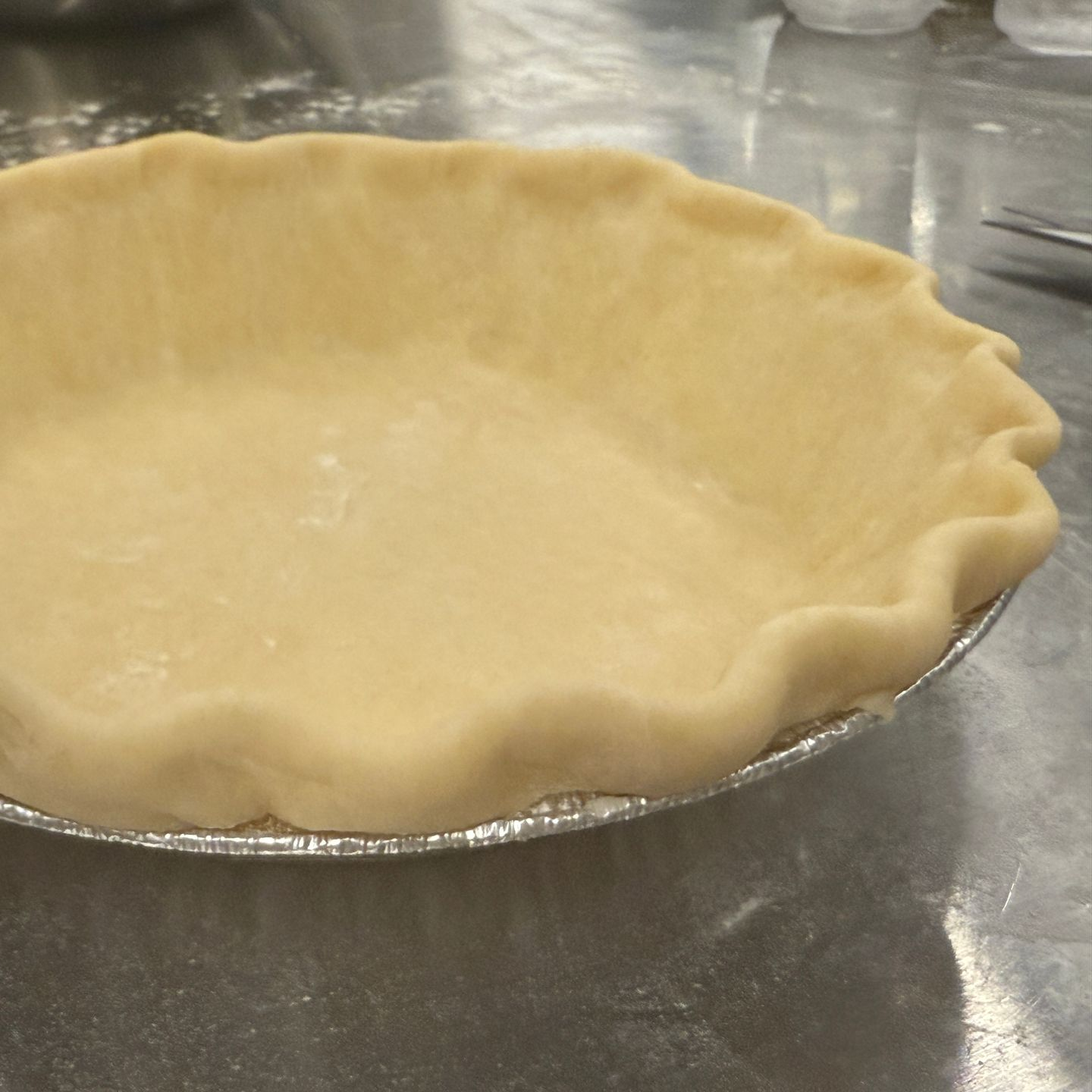
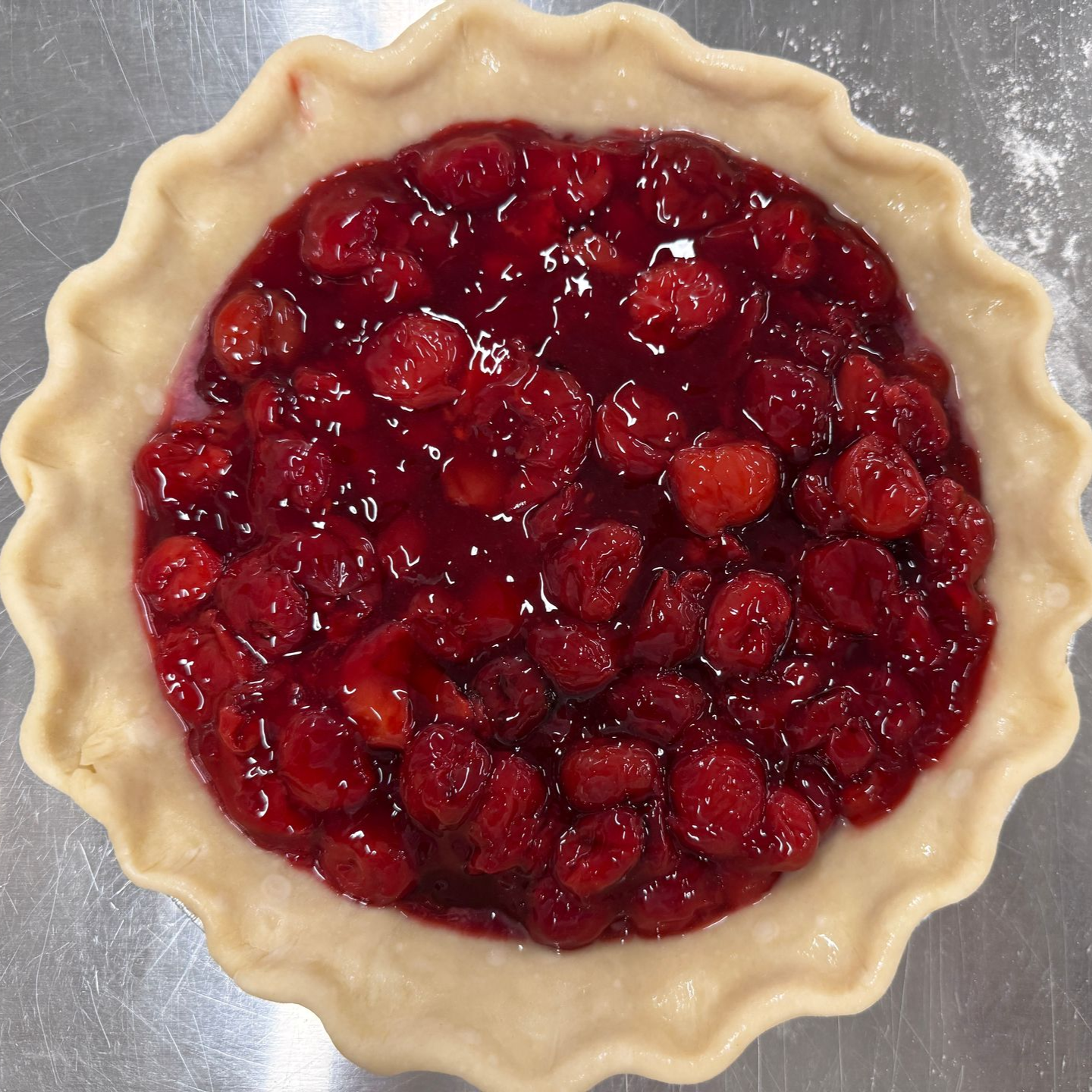
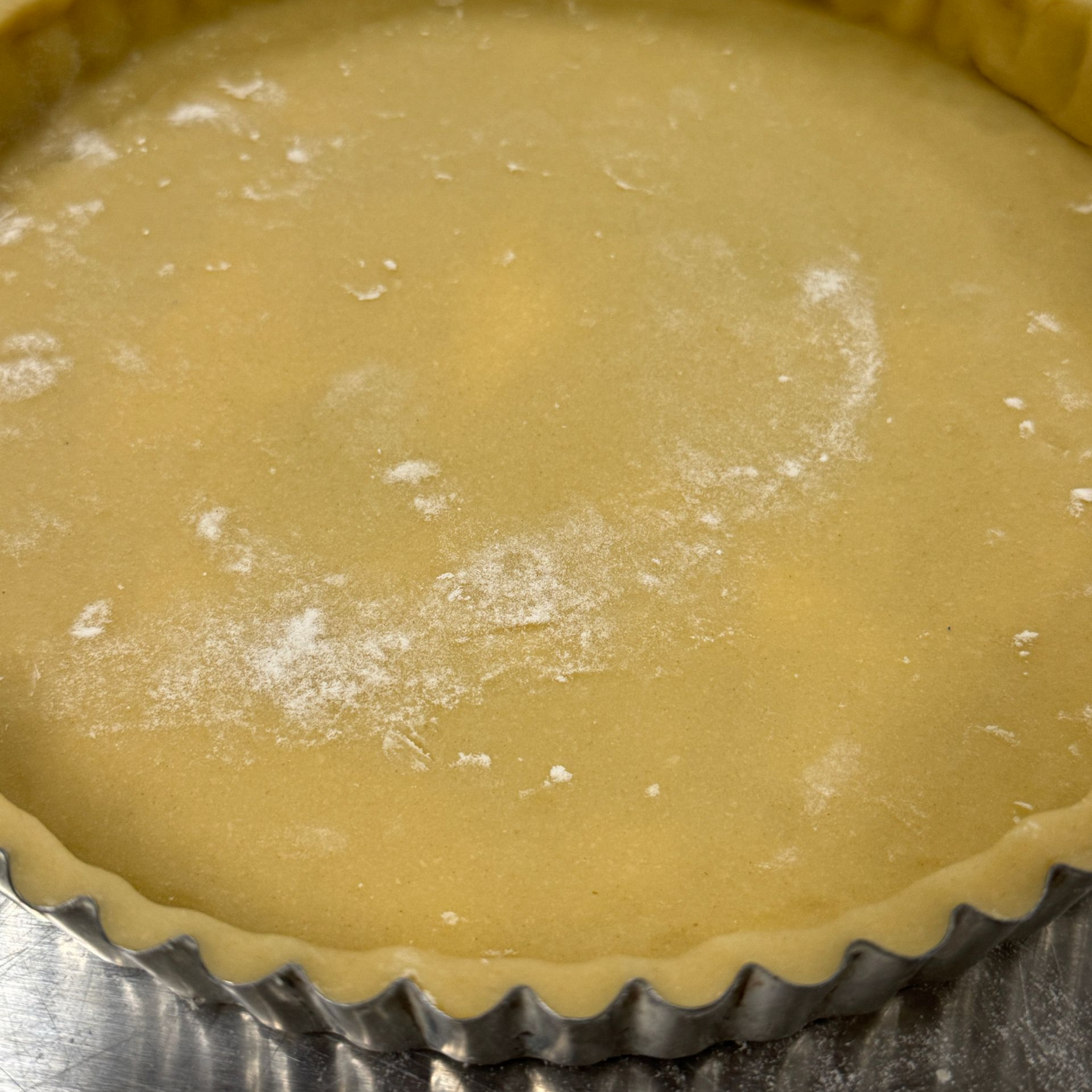
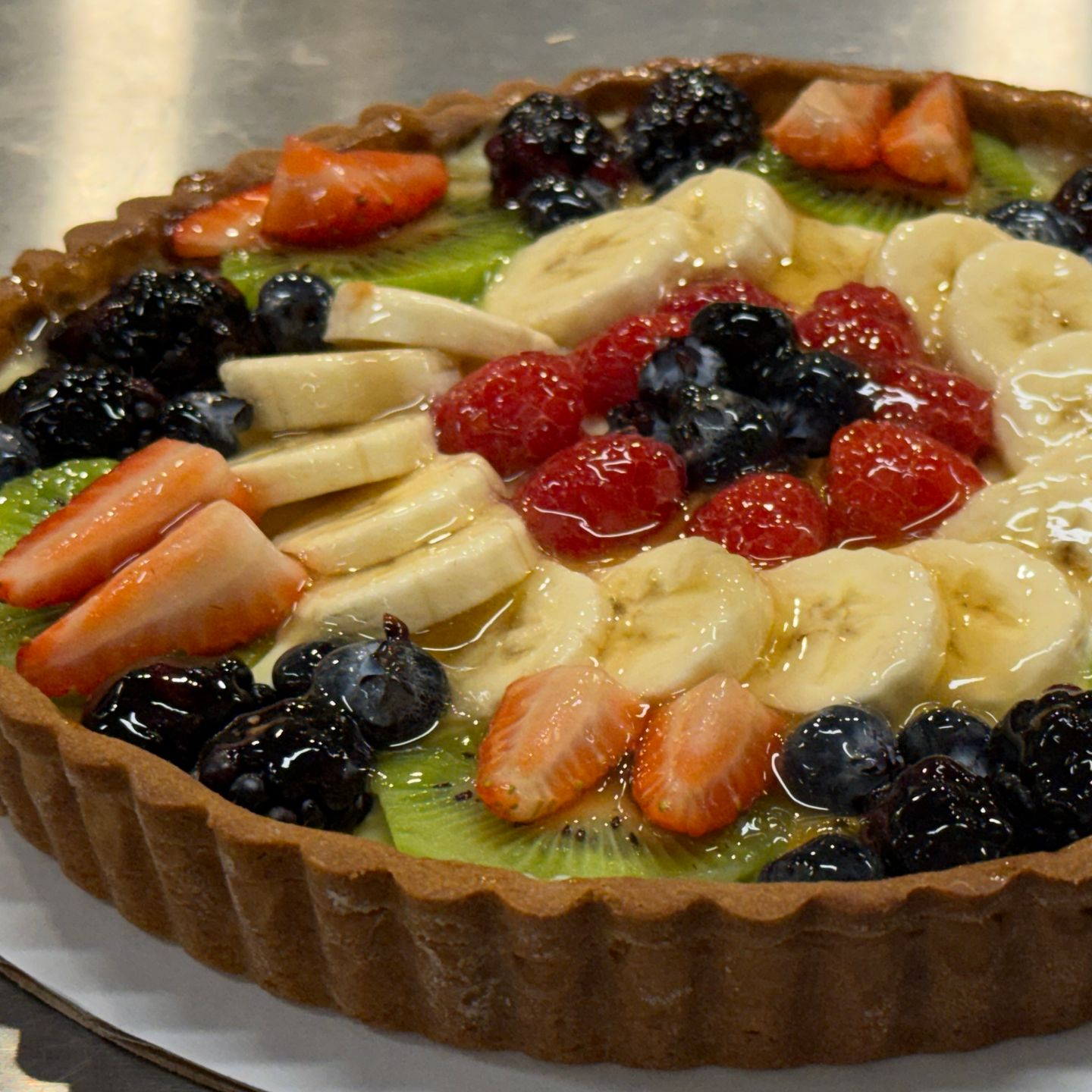
Tarts & Pastry Basics
- Prepare baked and unbaked tarts and tartlets
- Prepare a variety of special pastries based on puff pastry, choux pastry, and meringue-type sponges
- Prepare pâte brisée and short pastries
- Prepare puff pastry dough, blitz puff pastry dough, and reversed puff pastry dough, and make simple pastries from these doughs
- Prepare a pâte à choux (éclair paste), and make simple pastries from it
- Prepare a strudel dough, handle commercial phyllo (strudel) dough, and make pastries using either homemade or commercial dough
- Bake meringue and meringue-type sponges, and assemble simple desserts with these meringues (these are not pastries in the original sense of the word because they are not made from a flour paste, but they're used like flour pastries in combination with creams, fruit, fillings, and icings)
Pastry work is exciting and challenging where bakers can use creativity and imaginations to make so many different types of products.
Pastry comes from the word paste, meaning a mixture of flour, liquid and fat. In the bakeshop, pastry refers both to various pastes and doughs and to the many products made from them. The most important pastries are short doughs, puff pastry (aka pâte feuilletée), and eclair paste (pâte à choux).
Pâte Brisée and Short Pastries
The quality of pastry used to make tarts and tartlets is probably more important than the quality of pie dough. Tarts are generally thinner pies with less filling. The dough is a bigger feature of the finished product and not just a holder for the filling. The best are made with pure butter, not shortening, and they are enriched with eggs and sugar.
Pâte Brisée means broken dough, and is mixed with the same method as mealy pie dough - the fat is combined with the flour. In classical pastry, this is known as sablage (sah BLAHZH) or the sanding method. The fat and flour are mixed until it resembles corn meal or sand. Coating the flour with fat protects it from absorbing water and limits gluten development. Then you get tender pastry. Pie dough production is found on pages 294-296.
Pâte Sablée has even more fat than pâte sucrée and less egg and other moisturizers. It's crumbly and tender and is generally used for cookies but can be used for small tarts and other pastries. In French, sablée means sand. It can be used with the sablage method but it's most commonly mixed with the creaming method like a typical cookie dough.
Here, sablée dough is referred to the 1-2-3 dough, containing 1 part sugar, 2 parts fat, and 3 parts flour by weight.
Tarts aren't just pies without the top crust; they're light, usually less than 1" thick and are colorful. The appearance depends on carefully arranged fruit. Tartlets are individual-portion sizes.
Difference between pie and a tart
- Pie can be sweet or savory; dates back to the 1300s. If we take the word pie to mean any variety of food enclosed in a pastry and baked, then there have been pies for nearly all of recorded history. The word pie might be short for magpie, a bird that collects a variety of things, just as bakers do when they are assembling ingredients to bake in a pie. In the Middle Ages, pie almost always referred to savory pies containing meats, poultry, or game. North America turned pies away from savory and toward sweet. Fruit pies, especially apple are popular.
- Tarts aren’t just pies without the top crust. They are more closely related to other European-style pastries. They are light, less than 1” thick, and colorful. Tarts contain less filling than pies. Regular pie dough can be used, but more often richer, buttery doughs are used.
- They’re both pastry-based dishes with fillings but differ in their pans, crusts, and presentation. Pies use deeper, sloped-sided dishes with flakier crusts and served from the pan and can have a top crust, whereas tarts use shallower pans with straight sides for a firmer, crumblier crust, are unmolded for presentation, and have open tops usually.
Difference between flaky and mealy pie dough
- Mealy – Cutting butter until it resembles cornmeal. Mealy pie dough needs the butter to coat the flour particles. Used for juicy pies (fruit pies) and cooked custards)
- Flaky – Cutting butter the size of a pea. Dough needs to be large enough to allow for a flaky, tender crust. Use as a bottom crust, but typically better as a top crust.
Definition of tart
- Tart – A shallow pastry crust filled with a sweet or savory mixture before or after baking. It may be straight or fluted sided and made free-form or in a tart pam, tartlet pan, or flan ring.
Three types of tart doughs
- Pâte Brisée – Biscuit method; Pastry flour, salt, sugar, butter, eggs, water, vanilla
- Pâte Sablée – Creaming method; butter, confectioners’ sugar, lemon zest, vanilla, eggs, pastry flour
- Pâte Sucrée – Creaming method; butter, sugar, salt, lemon zest, vanilla, eggs, pastry flour
Prevent soggy pie shell
- Careful to use milk because of the added sugar and fat – could cause a heavy, soggy crust
- Using too much sugar can absorb moisture and create soggy crust.
- Brush crust with either butter or egg wash prior to filling before baking.
- Par-bake then fill and finish baking.
- Put sheet pan/oven proof tile in oven when pre-warming oven.
- Egg wash the top crust to allow for a completed shiny look.
What are the three types of bakes for a pie or tart and an example for those
- Straight bake – a pie/tart baked by adding filling, then going straight to the oven (pecan, pumpkin, or any pie with a longer bake time)
- Par-bake – a pie/tart baked partially then filled with filling to finish baking (key lime, lemon, baked chocolate)
- Blind bake – a pie/tart shell fully baked prior to adding filling (most custards, chiffons, any filling cooked fully prior to adding to shell)
Preparing for a par-bake and blind bake – add parchment or saran wrap to pie shell then add beans or rice. Put in oven and bake. For par, about 10-15 minutes. Blind bake time is 15-25 minutes depending on thickness of dough.
Various pies and tarts:
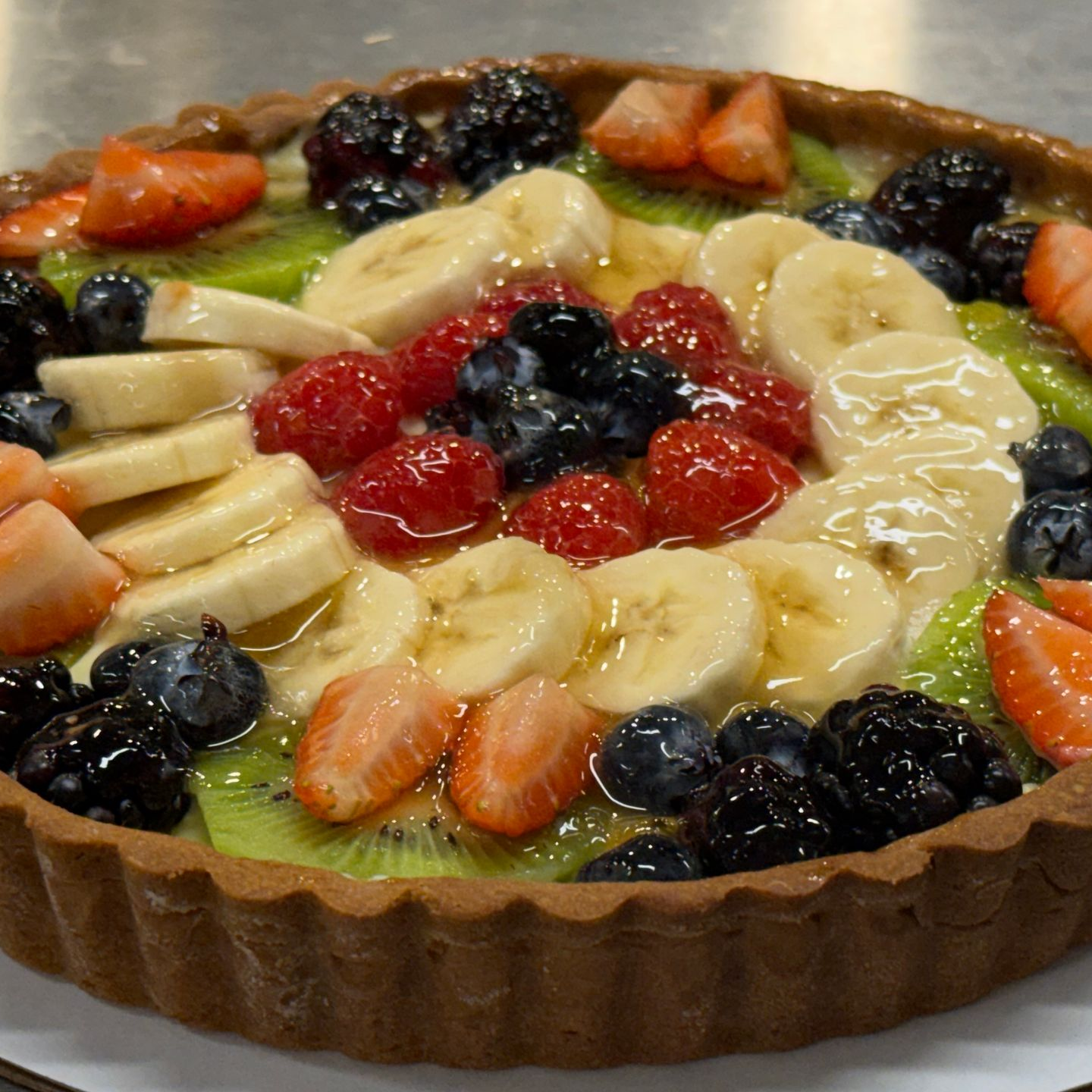
- Fruit pies/tarts – made with fresh, canned, frozen or dried fruit, mixed with sweeteners and thickeners
- Cream pies/tarts – smooth cream filling like pastry cream
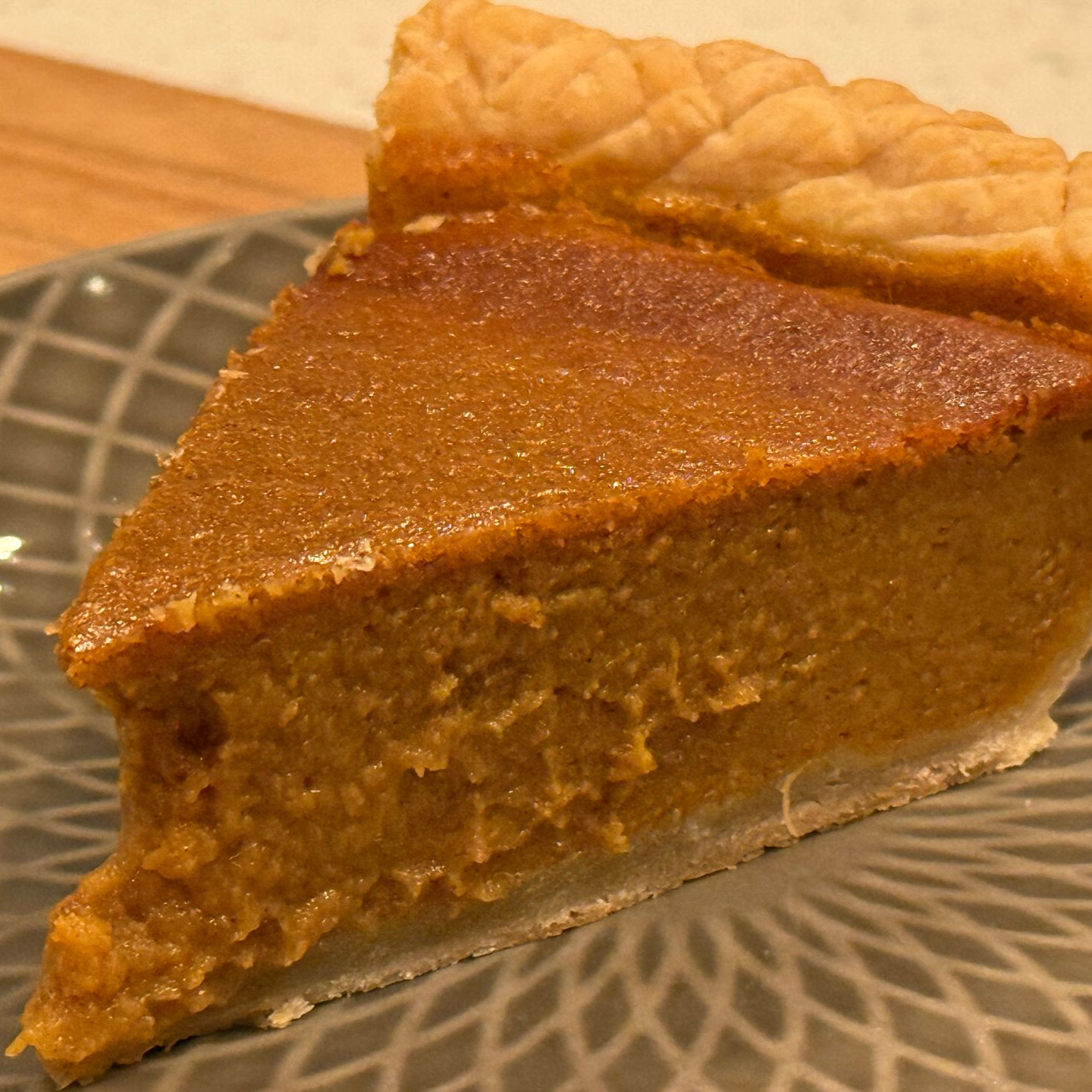
- Custard pies/tarts – thickened with eggs and sometimes starch, sweetened with syrups
- Chiffon pies/tarts – typically fruit based fillings with chiffon folded in after cooking, typically low in fat
Final Production
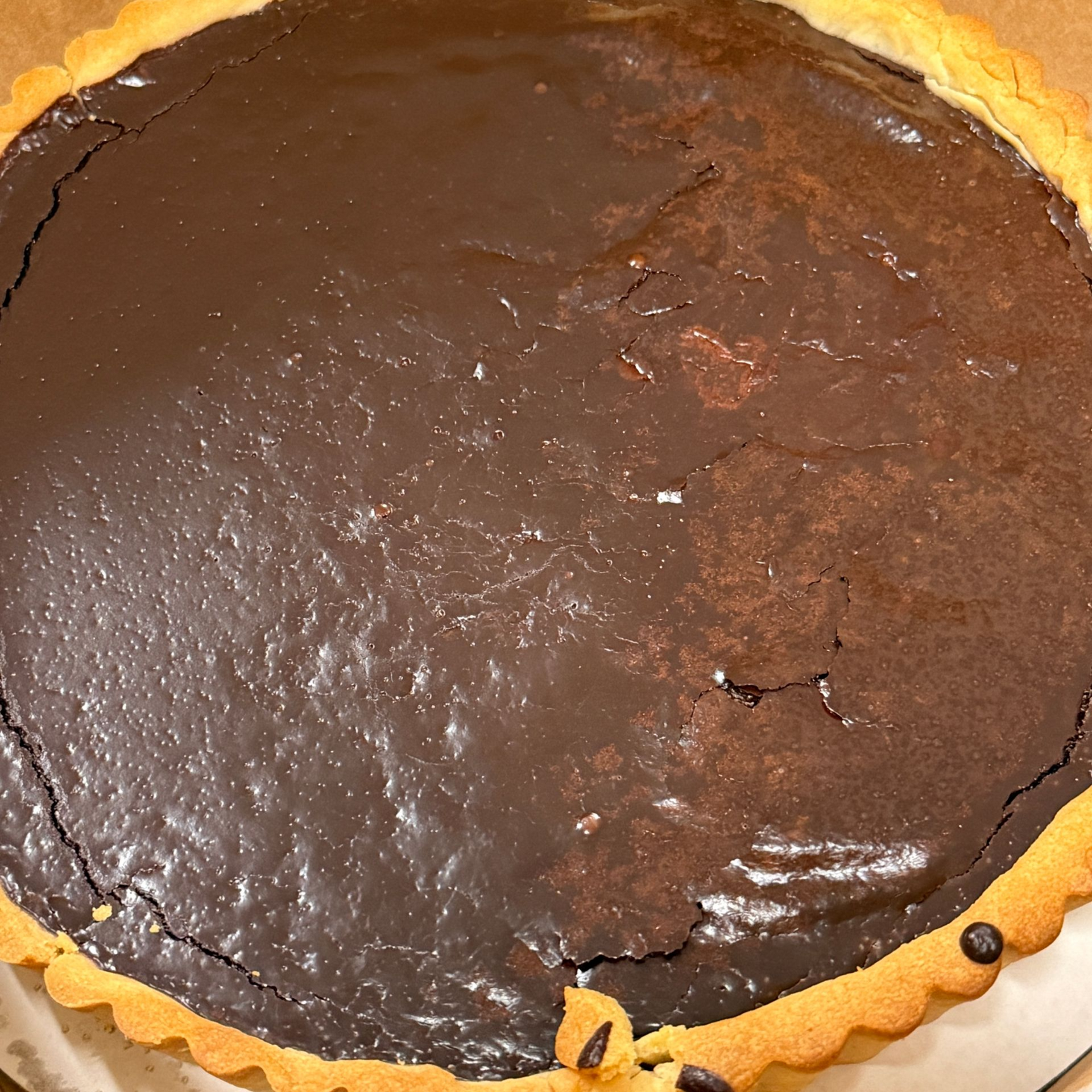
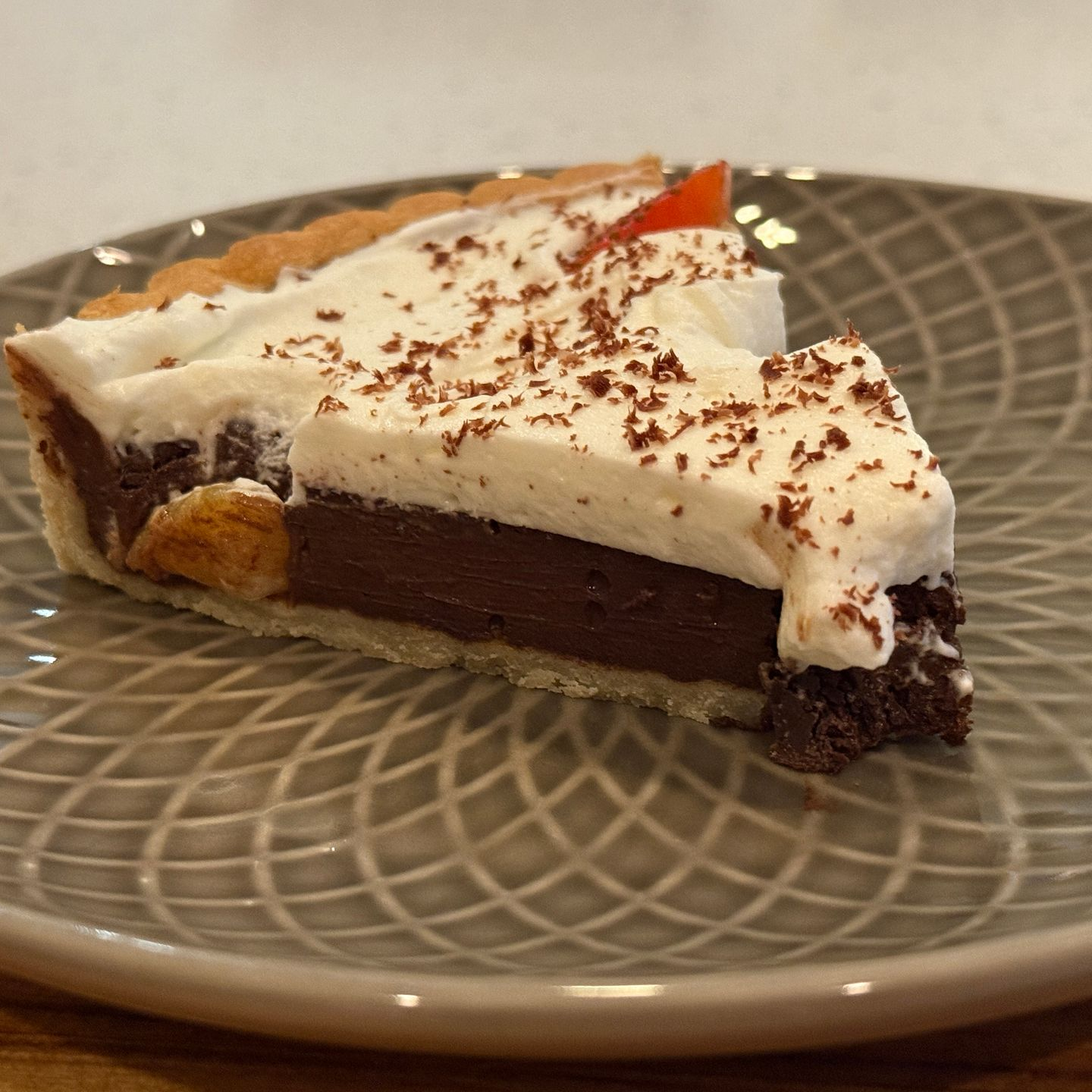
For our final production in class, we made a chocolate tart. This follows the same principles of making the pastry cream.
I left the tart in the oven too long and it began to darken and maybe even curdle on half of the tart. I should have taken it out at 10 minutes, but left it for 12 minutes. I also didn't appreciate the bitter taste of this chocolate tart - rather unsatisfying. I would instead have used semi-sweet chocolate. I rated myself on the product evaluation, below, as my best work is in the future.
Ingredients
- 6 oz heavy cream
- 6 oz milk
- 4 oz chocolate bittersweet
- 4 oz unsweet chocolate
- 1.67 oz egg (1 egg)
Method
- Fill tart pan with tart dough. Park bake, 10-15 minutes depending on thickness of dough.
- While tart is in oven, mise en place ingredients and follow this:
- Bring milk and cream to a simmer, pour over chocolate, whisk gently, then temper egg in to mixture.
- Pull tart from oven, remove beans, then slowly pour chocolate over filling into pan.
- Bake for 10-15 minutes, or until set.
From my product evaluation:
Taste (15 points):
For me, the taste was quite bitter due to the 4 oz of bitter chocolate. In addition to bitter, it tasted mildly sweet with buttery notes.
Texture (15 points):
After setting and under refrigeration, the texture turned out to be quite smooth with a nice bite to the crust.
Visual Appearance (15 points) (NOT A PICTURE):
Visually, the chocolate tart looked quite nice. Though, because I over baked the tart about two minutes, half of the tart looked darker and visually cooked a little too long. The other half looked lighter and how it should have looked.
Descriptive sentence of product (15 points) (Something you would read on a menu):
A chocolate tart is the perfect treat for the holidays, or any other regular day. The tart’s not so sweet that you can’t eat it. So enjoy it with some whipped cream or fruit.
Explain what you did wrong (if any) and how you could improve your work next time. (20 points)
I did many things wrong. I added the baking beans to the tart without first putting the saran wrap underneath it. I had missed that class when I was out of town and I think the concept didn’t solidify when I came back. I had to dig out the beans, put the saran wrap down, and then I made the mistake of wrapping the entire tart pan. This put me behind schedule and I was the last one in the oven, which is no big deal (someone has to be the last one in the oven). But I still struggle with confidence like when I’m trying to make the crust absolutely perfect. I would think that I need to review some of our production assignments, grow in my confidence level, and check my product at the least baking timer so that I can prevent over baking.
How could you have better utilized your time in producing your product? (10 points)
I needed to refresh myself on the saran wrap of the crust before adding the baking beans in. Other than that, the mise en place went well, and I feel like I was able to roll out the crust well and get the milk and sugar on the stove to make the custard like filling of the tart.
Recipes
Pâte Sablée (p. 327 in Professional Baking)
Creaming method
New desired yield: 24 oz
Ingredients
- 7.5 oz Butter
- 3.7 oz Confectioner's sugar
- 1/8 tsp Salt
- 1/2 tsp Lemon zest
- 2 drops Vanilla extract
- 1.2 oz Eggs
- 11.29 oz Pastry flour*
Method
- Cream together butter, powdered sugar, lemon zest (if using), and vanilla until mixture is smooth and pale.
- Add eggs a little at a time and beat well between addition.
- Add flour. With a plastic scraper, carefully blend into a soft dough.
- Divide into 2 discs. Wrap in plastic and flatten. Chill before use.
*Note: for this recipe, we increased the dough percentage by 1 oz to 12.29 oz and did not use lemon zest. We used one egg and 1/2 tsp vanilla.
*For chocolate pâté sablée, use 1.2 oz cocoa powder and 1/4 to 1/2 tsp grated orange zest.
Pastry Cream (p. 273 in Professional Baking)
New desired yield: 16 oz
Ingredients
- 9.85 oz milk
- 1.23 oz sugar
- .916 oz egg yolk/1 ish egg yolk
- 1.232 oz whole egg or 1 ish whole egg
- .768 oz cornstarch
- 1.232 oz sugar
- .611 oz butter
- .147 oz vanilla extract
Method
- Dissolve sugar into milk over low to medium heat and bring to a near boil.
- Beat the egg yolk and whole egg in a stainless steel bowl.
- Sift cornstarch and sugar into eggs. Beat with whisk until perfectly smooth.
- Temper egg mixture by slowly beating into high milk in a thin stream.
- Return mixture to heat and bring to a boil, stirring constantly.
- When mixture boils, continue to stir constantly for up to 2 minutes.
- Remove from heat, stir in butter and vanilla. Mix until melted and blended.
- Pour out into a clean pan and cover with plastic wrap directly touching the surface of the cream to prevent a skin forming on top. Cool and chill quickly.
Pie Dough
Biscuit method
New desired yield: 22 oz or 2 discs (11 oz each)
Ingredients
- 11.1 oz AP flour
- 7.1 oz butter
- 1/2 tsp salt
- 1/2 tsp sugar
- 3.5 oz water
Our original class recipe was for 4 discs (44 oz total) so the flour came out to 22.2 oz, butter 14.2 oz, 1/2 tsp of salt and sugar, and 7.1 oz of water.
Method
- Mix together flour, salt, and sugar in a bowl.
- Add fat (making sure it's still very cold) and mix together with pastry cutter or fingers. (For a flaky dough, cut fat down to a pea-size shape. For mealy dough, take fat down to resemble cornmeal consistency.)
- Add ice-cold water. With 3.5 oz, that will be about 6-7 Tbsp. (2 Tbsp = 1 oz)
- Work dough together with hands and form into a ball. If too wet, add a bit more flour. If too dry, add a little more cold water.
- Flatten into discs, cover with plastic wrap, and refrigerate.
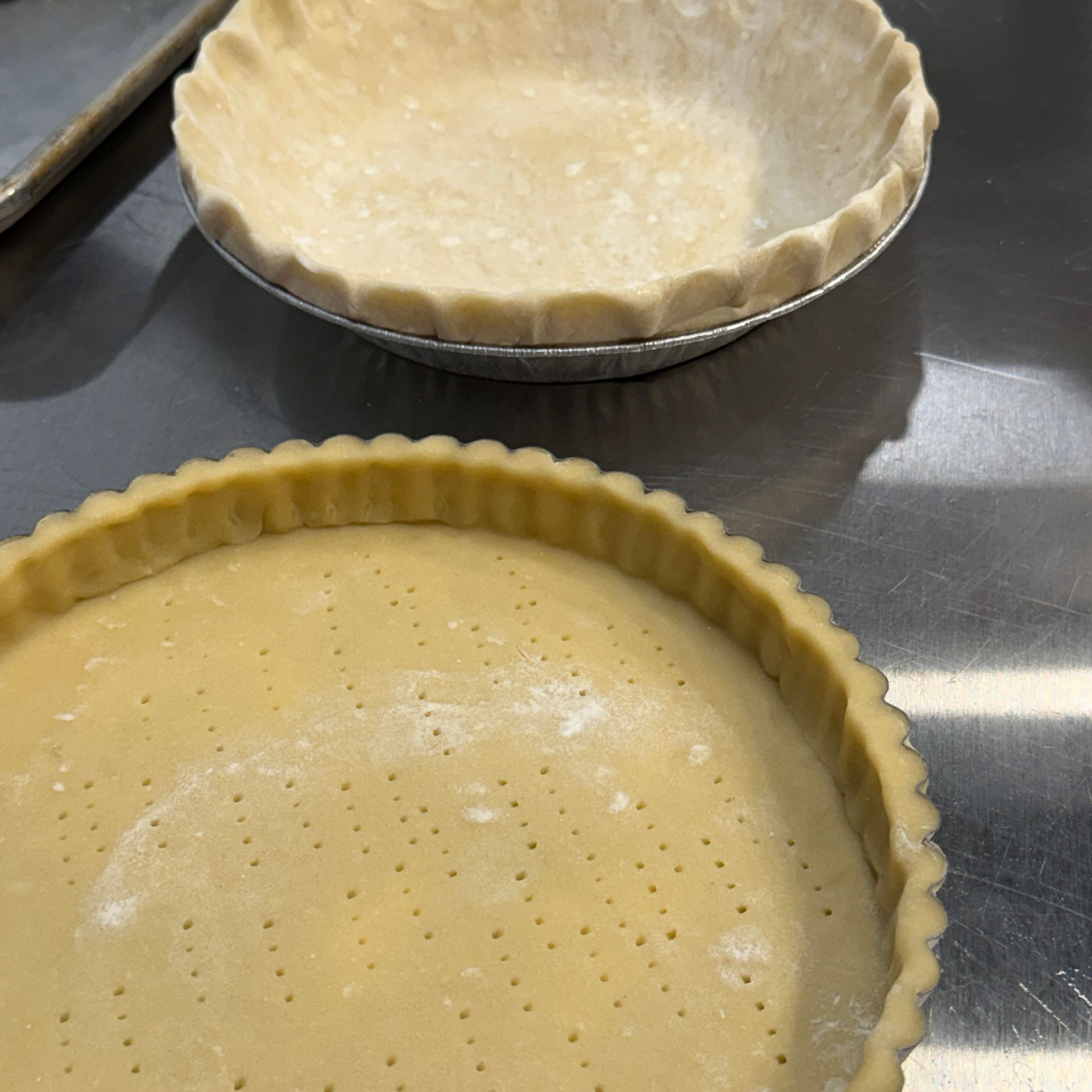
- After chilling, roll out dough into pan, gently guide dough into crevices of pan all the way around. Cut excess dough with kitchen shears and fold dough under to create a lip all the way around where you can then decide what kind of pattern or design to create in the crust.
- Refrigerate or freeze pan at this point before continuing.
04. BREADS & ROLLS
Bread is a baked dough of flour, water, and yeast. Some hard-crusted French bread contains only these ingredients and salt. Other breads may include sugar, shortening, milk, eggs, and flavorings. However, flour, water, and yeast remain the essential components of all breads.
12 steps to bread making
1. Scaling
2. Mixing
- Mixing time and speed incorporates all ingredients, develops gluten in flour for elasticity and extensibility.
3. Bulk Fermentation
- Bulk Fermentation -optimum for wheat 75-78 degrees. Major contributor to dough development/flavor development.
4. Folding
- Folding (not punching) -release gas, even out temperature, increase dough strength, redistribute yeast
5. Dividing
- Dividing - cut and weigh dough into desired portions
6. Pre-shaping or Rounding
- Pre-shaping or Rounding - creating smooth exterior without tearing in order to trap CO2 gases
- Changes random pieces into consistent shapes; Improves final look
- Tight shaping = more bench time
- Light shaping = less bench time
7. Benching
- Benching - relax dough (gluten) on bench cover w/flour sack cloth
8. Shaping or Make-up
- Hand molding into final shape time determined
- Examples: Oblongs, boules, baguettes
9. Proofing (final fermentation)
- Proof box provides ideal temperature/humidity
- Lean Dough 75 degrees/80 % humidity; Rich Dough 70 degrees/ 75% humidity - cooler due to butter content; Sour Dough 70-75 degrees (room temp) - longer ferment ideal to enhance flavor
10. Scoring (if needed)
- Done just as loading into oven creating controlled weak section for steam expansion
- Use sharp blade; avoid tearing or pulling
11. Baking
- Usually 420º in deck oven until center reaches 185º
12. Cooling
- Best in open air not too drafty-causes cracks
Bonus - Storing
Why ice water/cold ingredients in pie dough
- Helps keep the fat solid and slows down gluten development
Scoring
- Done just as loading into oven creating controlled weak section for steam expansion. Done just as loading into oven creating controlled weak. Can be used to identify types of bread or who the baker is. Use a sharp blade – avoid tearing or pulling.
Steaming bread
- Used for the formation of the crust
Three types of bread dough/example
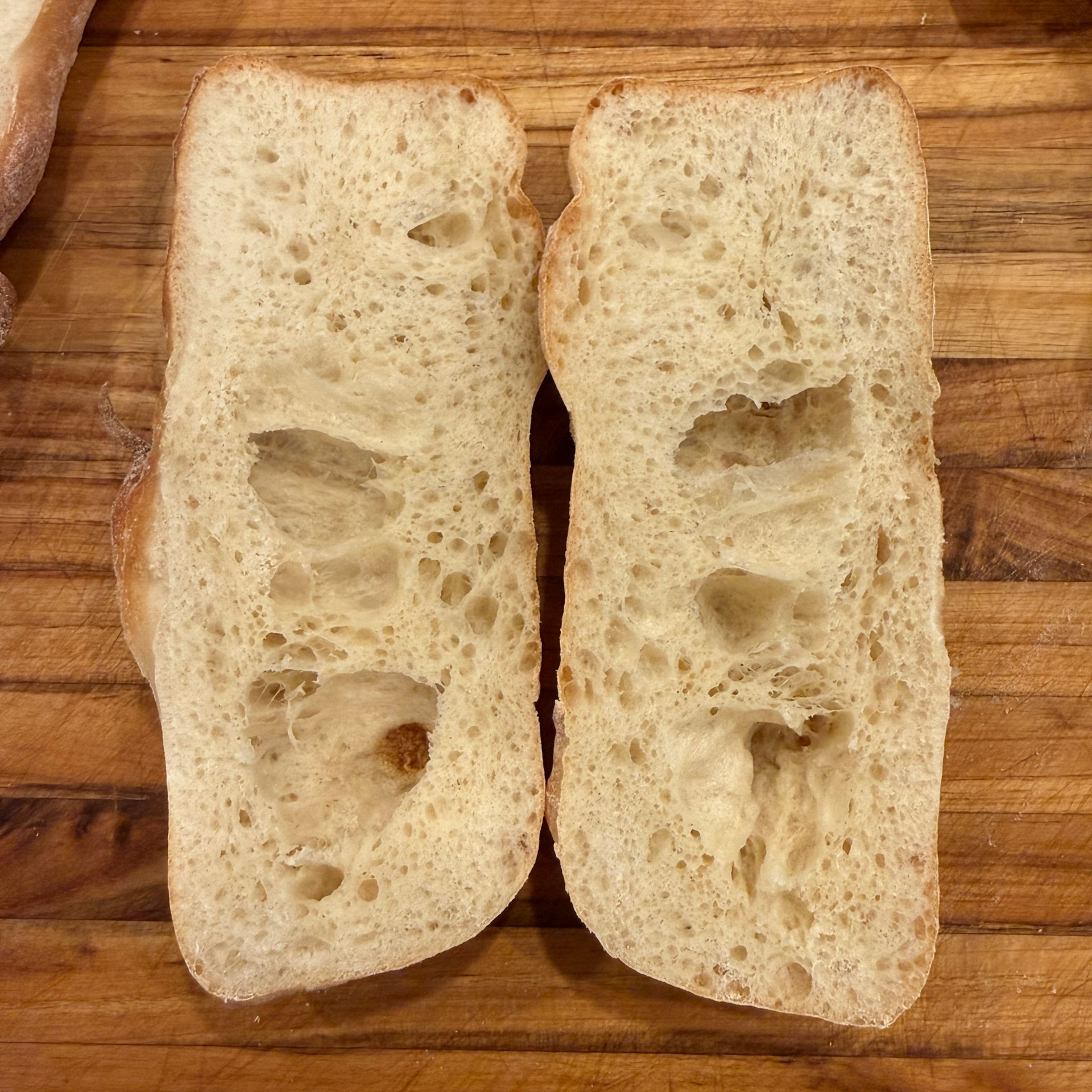
- Sourdough, rich dough (sweet dough), lean dough (ciabatta)
Fermentation of dough (extra credit question)
- Fermentation is the process by which yeast acts on the sugars and starches in the dough to produce carbon dioxide gas (Co2) and alcohol. Gluten development continues during fermentation times like bulk fermentation.
Yeast Breads
Yeast Activates: 100-110 degrees
• Yeast Dies: 138-140 degrees
• No cover needed in proof box
• Fully Baked at 180 degrees –due to protein coagulation
• Best with steam (2x steam with sour dough)
• Over proofed: taste yeasty and smells like alcohol.
Three types of yeast: Active, Instant, Fresh
Water
Water temperature can be manipulated in order to obtain correct dough temperature or desired dough temperature (DDT)
• By manipulating water temperature being added to a dough recipe we are able to achieve optimal temperature in our final dough even after mixing friction has occurred.
• EX 1: cool water in recipe with ice
• EX 2: warm water in recipe using microwave
• Water is responsible for consistency of bread dough
• ie. more water = softer, loose dough (ciabatta bread)
• less water = firmer dough (French bread)
• Hard water best due to higher acidity than soft water
• Non-chlorinated water preferred in sourdough or levain culture since chlorine can inhibit developing
microorganisms
Salt
Without salt in bread dough it would be flavorless, sticky, and difficult to work-up.
• Salt is hygroscopic (attracts moisture)
• Enhances flavor
• Tightens gluten structure, which strengthens gluten
• Slows yeast fermentation
• Slows sugar consumption
• Delays dough oxidation
• Best to add at beginning of mixing to preserve carotenoids which add flavor and
aroma to bread
Eggs
Impart flavor due to richness in yolk
• Impart color
• Increase nutritional value (protein, calcium, iron, potassium)
• Gives even texture and grain to final product due to coagulating
property of eggs
Sugar
Sugar is hygroscopic (attracts moisture)
• Adds sweetness
• Adds extra color to the finished loaf
• Slows yeast fermentation because it absorbs extra moisture
Fats - shortening/butter
Fats coat gluten strands during mixing, making baked goods more tender
• Causes close-grained cell structure
• Increases shelf life
• Animal fats (butter/lard) add aroma, rich color, delectable mouth feel, and exceptional taste
• Butter melts at body temperature contributing to mouth feel
Milk
Increases nutritional value such as protein and mineral content
• Lactose (natural sugar found in milk) caramelizes surface which imparts rich color
• Lactose also contributes to soft and even grain in bread crumb
• Dry milk often used due to increased shelf life
Inclusions
Anything added to that does not affect dough but will enhance flavor
• ie. Nuts, chocolate chips, raisins, apple chips, herbs, etc.
• Tip: best flavor acquired from roasted nuts
• Tip: only add herbs on surface of dough 10-15 min before fully baked to avoid burning temperature sensitive herbs
Mixing Methods
Straight – in all at once except salt or yeast a bit later
• Sponge – flour, yeast, water
- usually used in rich dough since fat and sugar will slow yeast growth (fermentation)
- can also be used with lean dough(s)
• Modified straight - cream in fats and sugar to get light and fluffy – soft
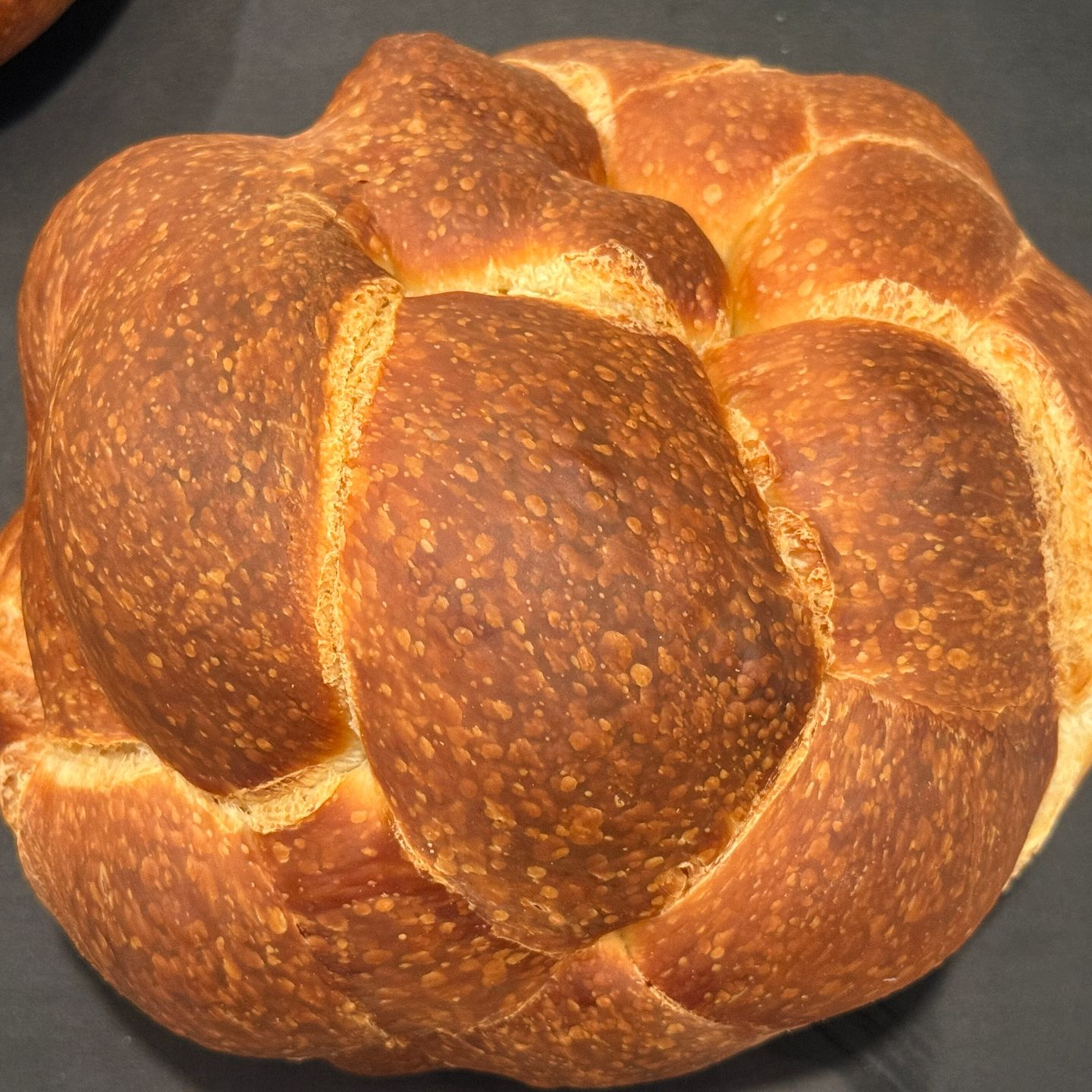
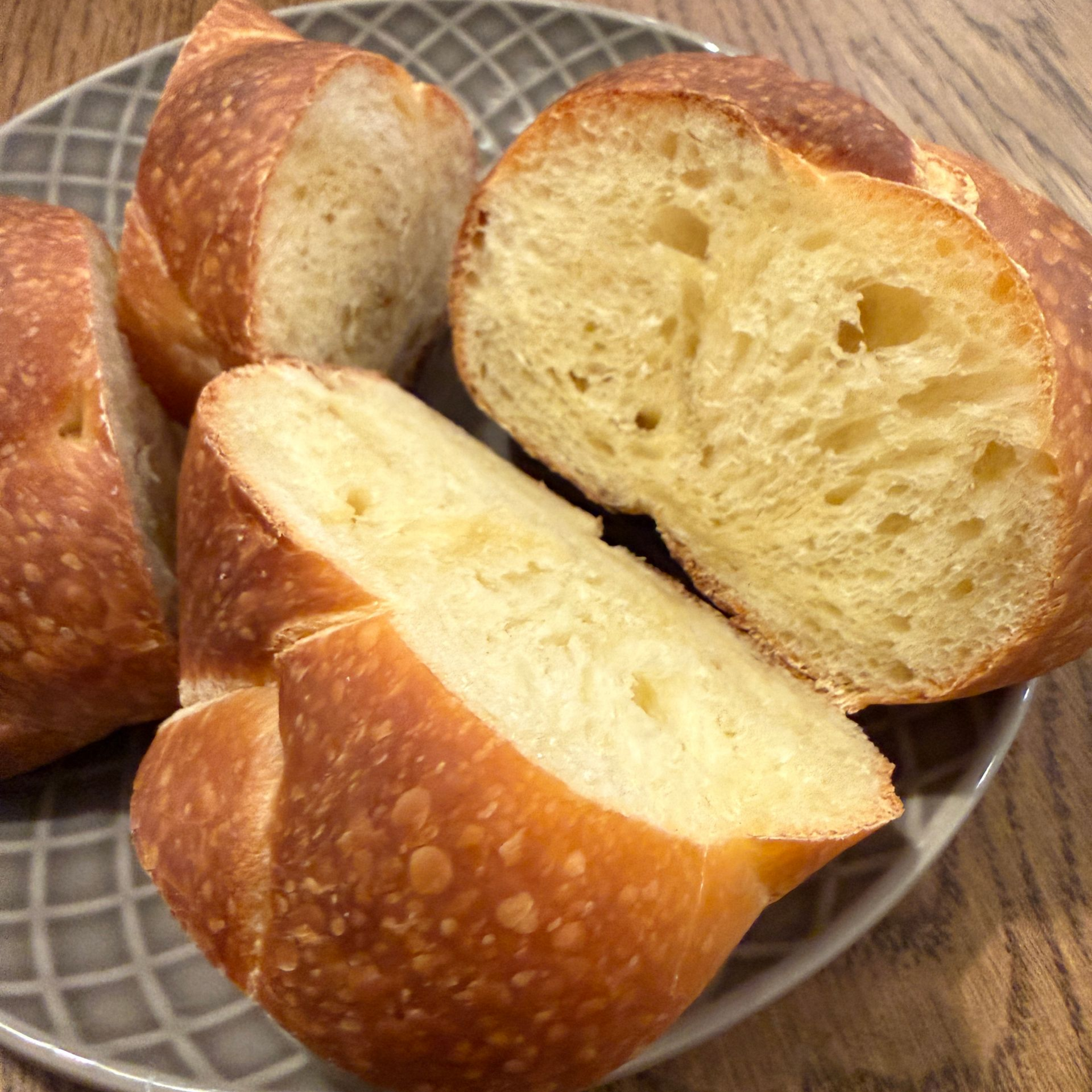
- Example: challah, rich doughs, some croissants, cinnamon rolls
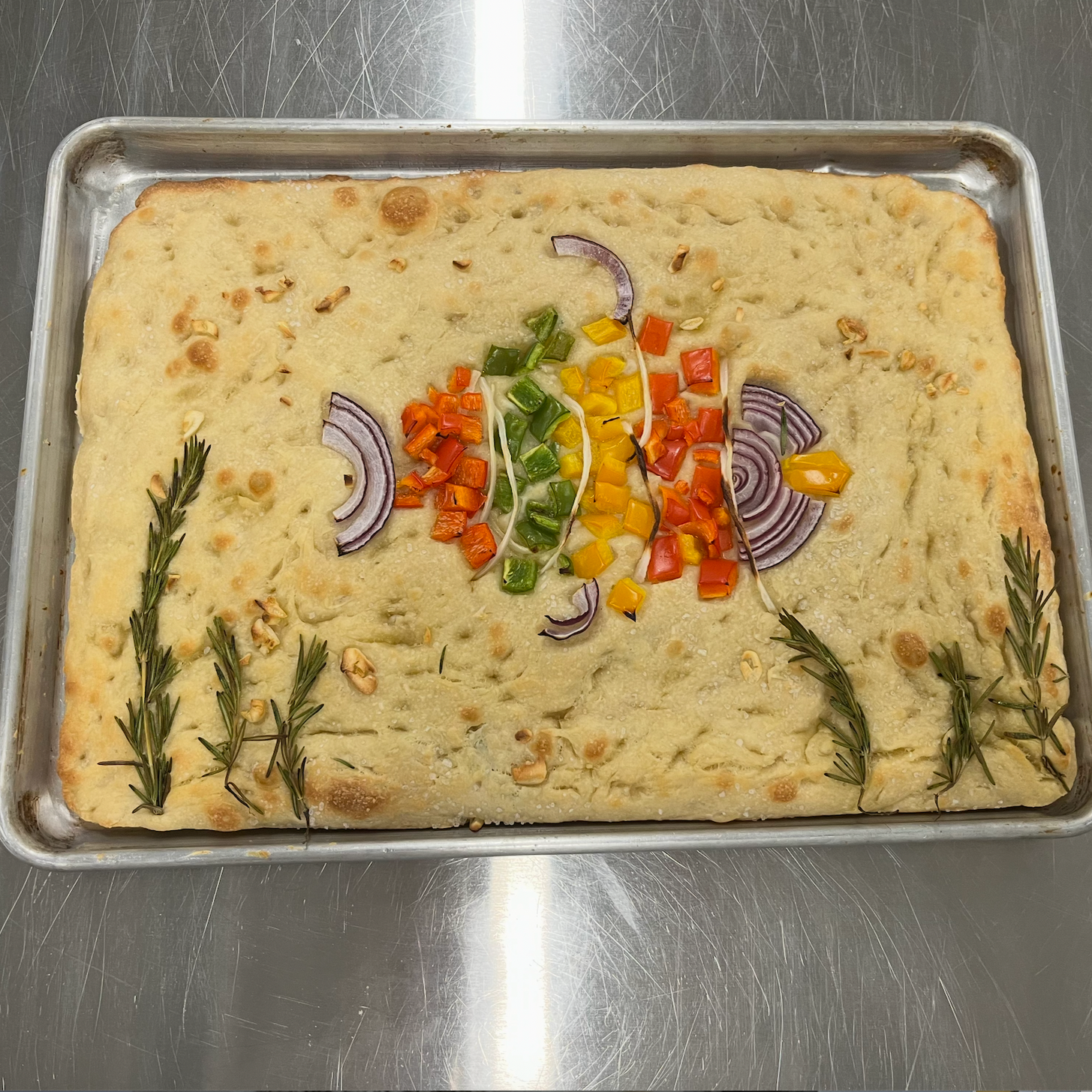
Focaccia - Please note there are two flours. You will need to add those flours together and divide the total combined weight of the flour by all the ingredients, including both flours. There is a new yield, please refer to the calendar.
Here is a video on how to make the sponge for your focaccia and ciabatta:
https://youtube.com/shorts/3kYHDFsoDbk?si=cLafEoixIOt2E99dLinks to an external site.
Ciabatta
New desired yield: 40 oz
Ingredients
Make the Sponge
- 14.5 oz bread flour
- 4.3 oz water
- 1/8 tsp instant yeast
For the Ciabatta
- 14.5 oz bread flour
- 6.2 oz water
- 1.5 t salt
- 1 t instant yeast
Method
- Mix together flour, salt, and sugar in a bowl.
- Add fat (making sure it's still very cold) and mix together with pastry cutter or fingers. (For a flaky dough, cut fat down to a pea-size shape. For mealy dough, take fat down to resemble cornmeal consistency.)
- Add ice-cold water. With 3.5 oz, that will be about 6-7 Tbsp. (2 Tbsp = 1 oz)
- Work dough together with hands and form into a ball. If too wet, add a bit more flour. If too dry, add a little more cold water.
- Flatten into discs, cover with plastic wrap, and refrigerate.
- After chilling, roll out dough into pan, gently guide dough into crevices of pan all the way around. Cut excess dough with kitchen shears and fold dough under to create a lip all the way around where you can then decide what kind of pattern or design to create in the crust.
- Refrigerate or freeze pan at this point before continuing.
Challah (p. 139 in Professional Cooking)
Straight Dough Method
New desired yield: 32 oz
Ingredients
- 17.57 oz bread flour
- 7.028 oz water
- .351 oz instant yeast (or 2 tsp)
- 1.317 oz sugar
- .105 oz maple syrup (3/4 tsp)
- ,351 oz salt
- 1.75 oz vegetable oil
Method
- Just one step: combine all ingredients in the mixing bowl and mix. If using instant dry yeast, it need not be blended with water first. If using other yeast, mix with water and allow to sit to activate. Mix until the dough passes the window pane test.
- Gluten development occurs during mixing, and continues during bulk fermentation and folding.
- Use braid technique for a braided dough challah.
05. SWEET DOUGH & SOFT ROLLS
Simple sweet roll doughs are easy to make and handle, but they need care because they're softer and stickier than bread doughs. This includes rich yeast doughs like brioche, croissants, and Danish rolls.
Soft Rolls
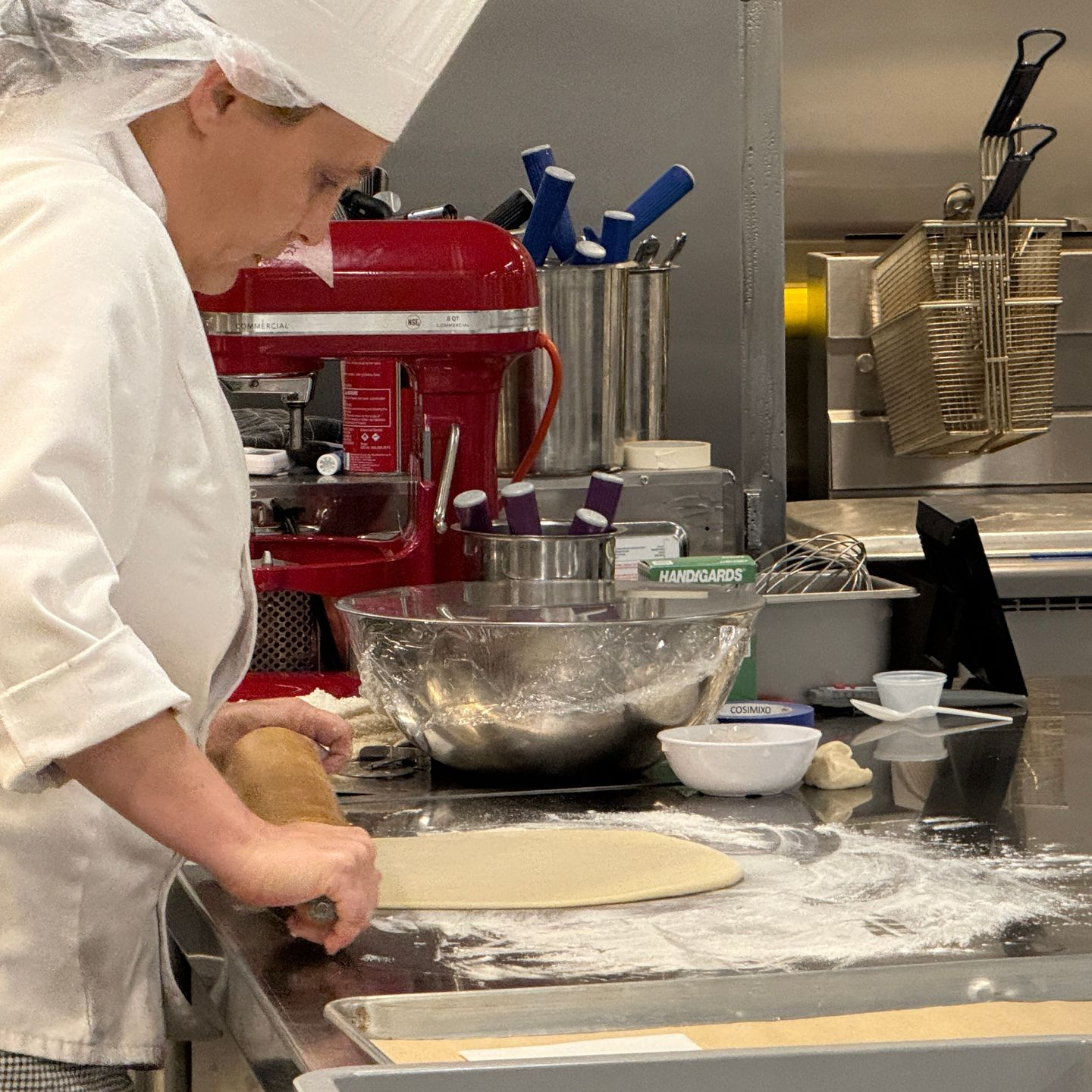
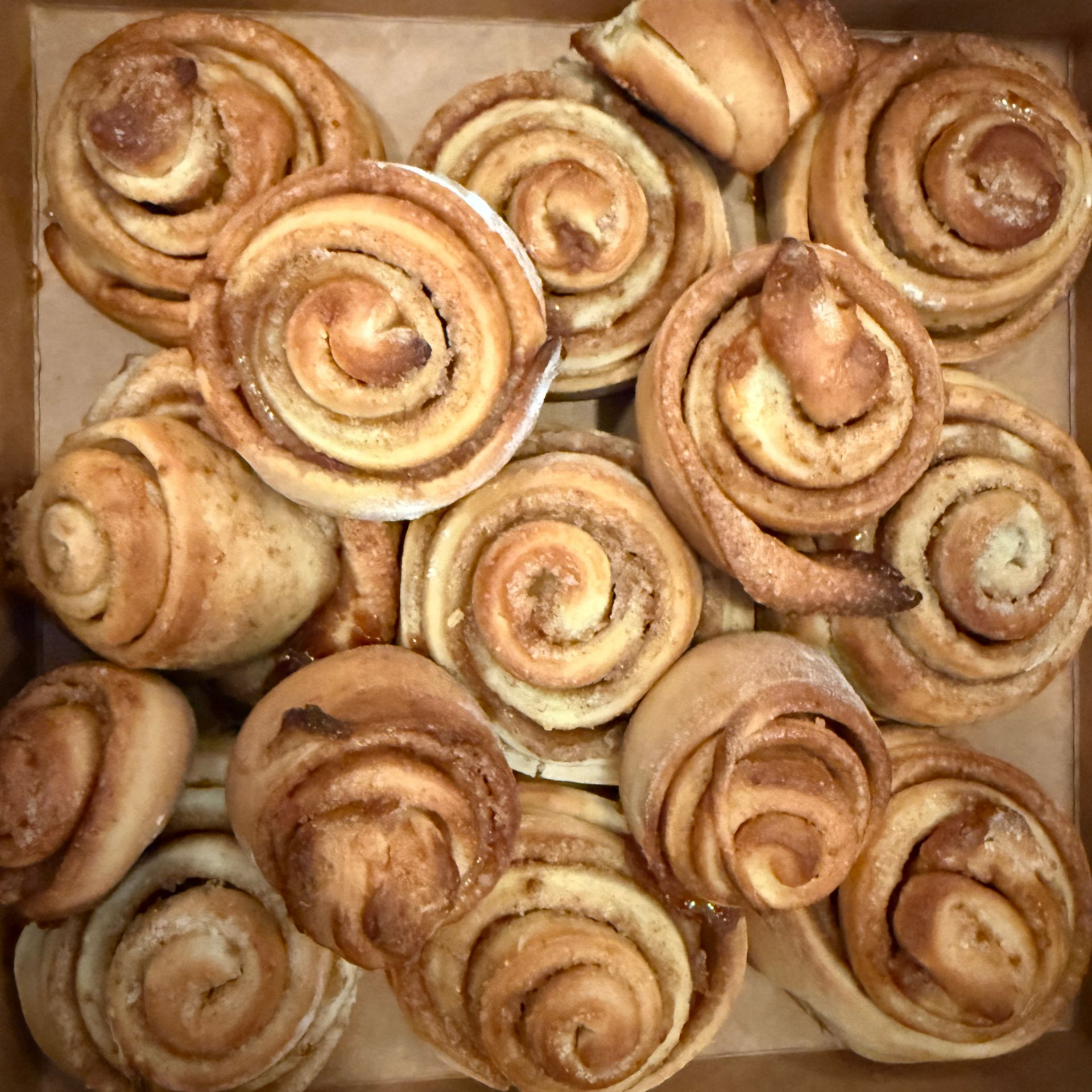
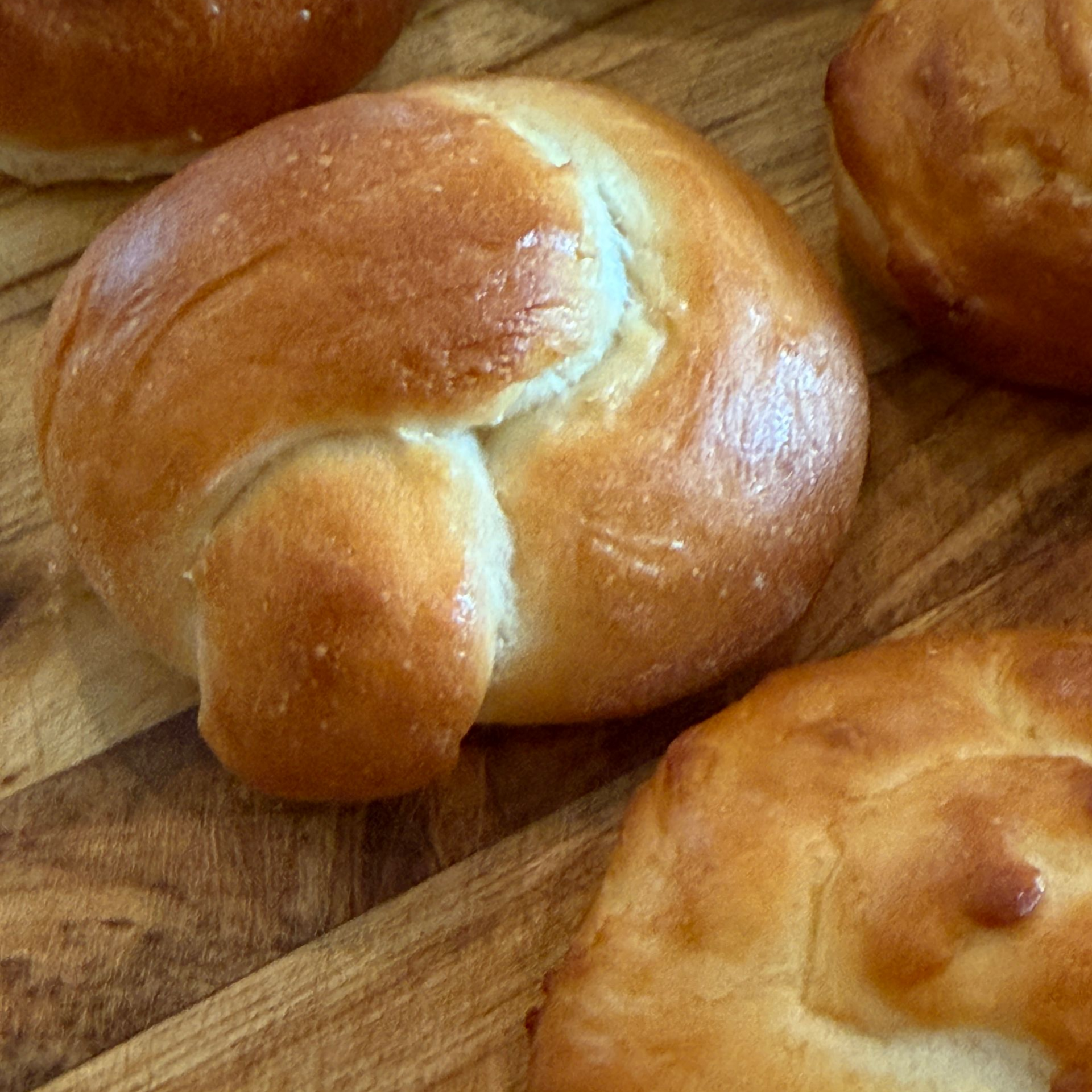
Soft rolls use the straight dough method on p. 124 of Professional Baking. The class recipe calls for a new desired yield of 19 oz using 10 oz of bread flour, 6.25 oz of water, .2 oz of instant yeast, .2 oz of salt, .95 oz of sugar, .47 oz of nonfat milk solids, .47 oz of shortening, and .47 oz of butter. Mix in a blender all ingredients together at the same time. Cover and allow to bulk ferment.
Sweet Roll Dough
For the sweet dough, a rich dough formula, this uses a modified straight dough method: If using fresh or active dry yeast, soften the yeast in part of the liquid, using a separate container. If using instant dry yeast, mix with the flour. Combine the fat, sugar, salt, milk solids, and flavorings and mix until well combined, but do not whip until light. Add the eggs gradually, but as fast as they are absorbed. Add the liquid; mix briefly. Then add the flour and yeast. Mix to a smooth dough.
Egg wash: Unlike lean breads, many sweet, non-laminated dough products and nearly all laminated dough products are egg-washed before baking to give them a shiny, evenly browned, tender crust.
Proofing: For most rich dough goods, keep the proofing temperature at 80 degrees F or lower. Too high a proofing temp can melt the butter in the dough, especially laminated doughs.
Baking: As for lean dough goods, some steam is beneficial at the beginning of baking. Because it delays crust formation, steam allows the products to rise more fully while baking and take on a lighter texture. But too much steam can cause damage to the egg-wash coating. After baking, allow time to cool slightly before removing from pans or handling them. Their structure is still fragile when hot, but becomes stronger as they cool.
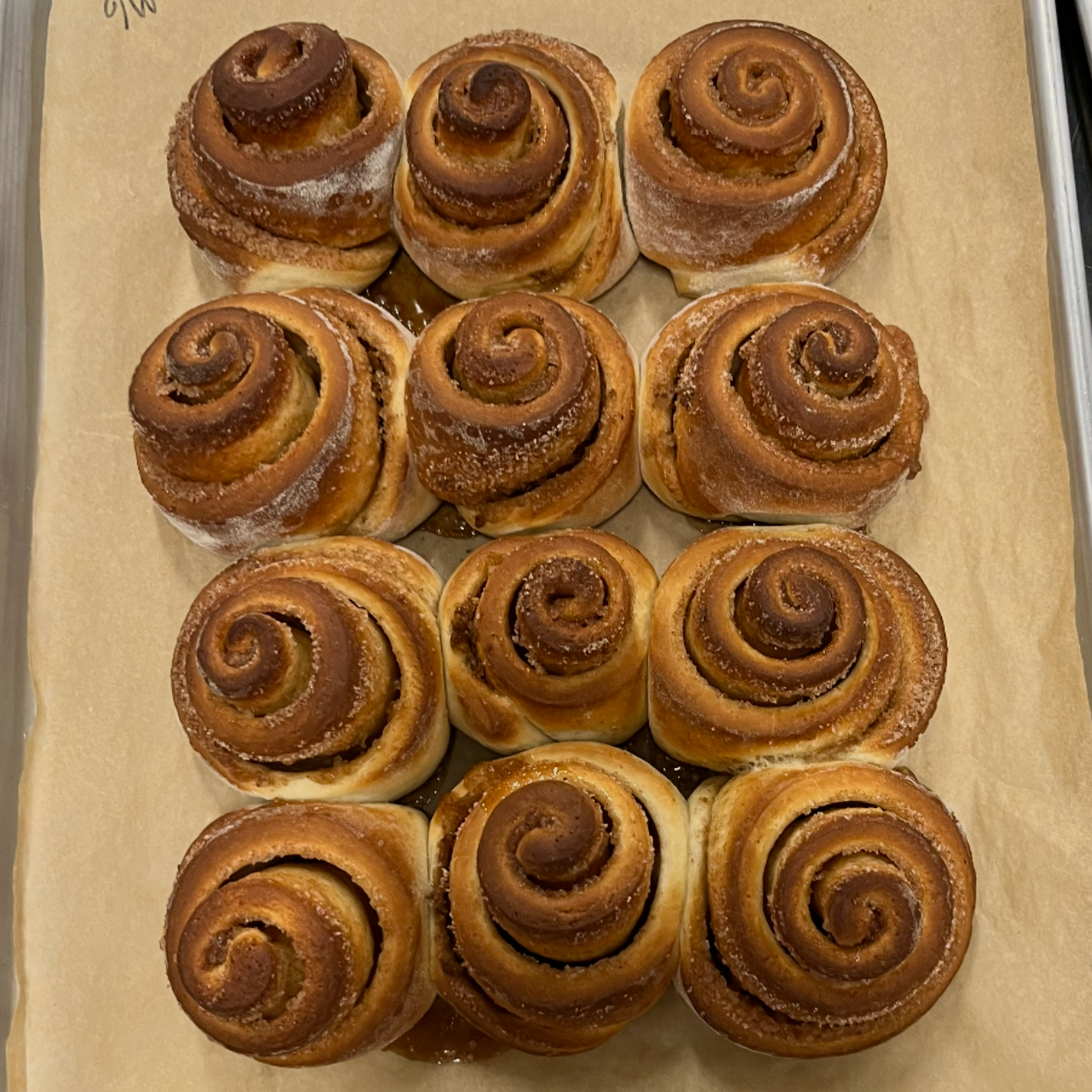
For the sweet roll dough recipe from class, our new desired yield is 32 oz. Use: 2.1 oz butter, 2.1 oz sugar, .210 oz of salt or 1 1/2 tsp, .526 oz nonfat milk solid or 3 1/2 tsp, 1.578 oz of eggs or 1 egg, 10.5 oz of bread flour, 10.5 oz of cake flour, .210 oz of instant yeast or 1 1/2 tsp, and 4.2 oz of water.